We've Moved


We've Moved!

Dave Donelson Tee To Green has an exciting new home at
Westchester Magazine.

We're still about all things golf, especially those pertinent to golfers in Westchester and the NY Metro, but now we're in a much bigger space!

Please visit our new home at


Showing posts with label club fitting. Show all posts

Thursday, November 13, 2014

Fitting Experience at New York Golf Center

There's not a single golf course on the island of Manhattan, but that doesn't mean golfers have to jump on a train to get expert help with equipment.  In fact, those who live outside the city might want to head in for a fitting session at New York Golf Centers (NYGC).  The company this year joined with club-fitting giant Cool Clubs to provide state-of-the-art club fitting with spectacular technology and proprietary software.


I recently went through a driver fitting with Josh Chervokas, COO of NYGC and director of their custom shop. I knew it was time, given the fact that it's been three years since my last fitting and not only has club technology advanced in that time, my body has changed (not necessarily for the better). Not to worry, Josh said as we started, "Our goal is to create a club that fits your body, not make your body perform to your club's specifications."  Made sense to me, especially when he measured the driver I've been using and pointed out that the shaft is stiff-plus and the swing weight a hefty D6.  That worked fine in my youth, but given the health problems I experienced before this season started, it wasn't surprising I've lost a lot of yardage off the tee using that sledge hammer.

Using Trackman and Cool Club's technology, Josh found that my "smash factor" (the ratio of ball speed to swing speed) was excellent and my ball spin was acceptable. Where I would get lower scores was with a higher ball flight and less dispersion off the target line.  I might not pick up much total distance, but I'd spend a heck of a lot more time in the fairway.  Needless to say, that worked for me.

New York Golf Center has more than 12,000 demo combinations of club heads and shafts to try. Josh's expert eye narrowed those choices down to a select few for me and I tried a half-dozen combinations until he found one that produced the desired result. Once the correct fitting files were created, order fulfillment will take place at Cool Clubs' Scottsdale, AZ headquarters factory.  The system is a perfect fit for both companies--and for me.

"We are excited to be working with a true partner in Cool Clubs," Josh said. "Our company philosophies really meld well in that we are both always striving to be the best. And to this end, we have each achieved great individual success. Cool Clubs CEO Mark Timms and I are always exploring ways to improve, so I'm not just excited about the capabilities we have added now but also about the future innovations we can develop together. This partnership is great for us and for the industry as a whole, and it will be the driving force in custom fitting as we look to the future of the game."

Club fitting really isn't something you should think about--it's something you should do.  Properly-fitted clubs can erase strokes more quickly from your game like almost nothing else.  It's not an expensive luxury, either. A driver fitting at NYGC is only $125, which is pretty reasonable when you consider what you'd spend on the driver in the first place. Doesn't it make sense to buy one that sends the ball where and as far as you want it to go?

New York Golf Center is an eight-time winner of Golfworld's Top 100 award and the only Golf Digest Top 100 fitting center in New York City. There are two convenient locations and a third pro shop at Chelsea Piers.

Among many other books, Dave Donelson is the author of Weird Golf: 18 tales of fantastic, horrific, scientifically impossible, and morally reprehensible golf

Monday, June 30, 2014

Free Club Fitting? Remember, There's No Free Lunch

Free club fittings at retail golf chains sound like a can't-miss deal. But, like the proverbial free lunch, it may not turn out to be what you hope. A 22-handicap golfer (who wishes to remain unnamed) recently went to one of the new golf stores for a custom club fitting three different times and got three different suggestions.  Huh? Where's the "science" in the process?

Woody Lashen
“Having an ill trained, inexperienced club fitter can have serious effects on your golf game,” said Woody Lashen, co-owner of Pete’s Golf Shop on Long Island.  The fitter has years of experience and brings an engineering degree to the fitting studio. “An experienced fitter recognizes swing flaws from ill fitted equipment," he says. "Counter to what these chains push on golfers, our philosophy is that a brand neutral approach is the best way to find the best clubs for your game."

Lashen says a proper fitting should start with an earnest discussion between the golfer and the club fitter.  The conversation should reveal what the player is looking to accomplish with their golf game and include how often they play, their handicap, and the problems they typically encounter on the course. This will help provide a base line with their current clubs.  Lashen adds that it may be determined that you can't do better, so there’s no need for new clubs.

The available technology to help determine the many elements of a set of clubs, is tremendous.  But if the fitter does not have a full understanding of the technology, it doesn't help.

Compounding the problem is that certification of club fitters is inconsistent and unreliable, which leaves word of mouth as a key resource to find a reliable one.

“Club fitting is part technology and part art," Lashen says. "We have found that for the men and women who come to us, their club fitting goes a long way to help them increase their enjoyment of their time spent with friends and business associates on the golf course."

Among many other books, Dave Donelson is the author of Weird Golf: 18 tales of fantastic, horrific, scientifically impossible, and morally reprehensible golf

Thursday, June 19, 2014

NY Golf Center Adds Cool Clubs Fitting Technology


Custom clubfitting giant Cool Clubs has teamed up with NY Golf Center. The New York City retailer has begun using Cool Clubs Fitting Technology and proprietary software with Trackman, to help customers get the best fit possible.

In line with all Cool Clubs fitting locations, NY Golf Center will have more than 12,000 demo combinations of clubheads and shafts to fit golfers. Once the correct fitting files have been created for a golfer's new clubs, order fulfillment will take place at Cool Clubs' Scottsdale, AZ headquarters factory, with all of the modern technology used to build to the correct fitting specifications.

"We are excited to be working with a true partner in Cool Clubs," says Joshua Chervokas, Chief Operating Officer of NY Golf Center. "Our company philosophies really meld well in that we are both always striving to be the best. And to this end, we have each achieved great individual success. Cool Clubs CEO Mark Timms and I are always exploring ways to improve, so I'm not just excited about the capabilities we have added now but also about the future innovations we can develop together. This partnership is great for us and for the industry as a whole, and it will be the driving force in custom fitting as we look to the future of the game."

The NY Golf Center Shop was launched in summer 2008, offering players golf's most comprehensive fitting options coupled with tour caliber build, repair and customization services. To provide players an opportunity to test the latest high-end and TOUR-only products, N.Y. Golf Center features Cool Clubs proprietary fitting carts, software and frequency machines. That's one of the reasons it's recognized as a Golf Digest Top 100 Fitting Center and an industry leader in custom fitting.

"Our center powered by Cool Clubs fitting studios features the most comprehensive fitting and build services available," says Chervokas. "From the new player looking to get a value priced starter set or the most-demanding player seeking the best clubs money can buy, we can fill all golfers' needs to ensure their best golfing experience."

Likewise, Cool Clubs executives are elated by this new partnership. "We believe this venture with N.Y. Golf Center is an amazing opportunity for both companies," says Vito Berlingeri, Cool Clubs Marketing Director. "It's a marriage of two leaders that ultimately will provide the greatest-possible benefit to golfers."

Cool Clubs has its headquarters in Scottsdale, AZ with 14 locations worldwide, including two Locations in Tokyo, Japan and Sanctuary Cove, Australia. Cool Clubs offers a variety of club fitting services for all types of golfers: tour-level professionals to beginners who want to give themselves a better opportunity for rapid game improvement. From driver and long game fittings (hybrids and woods) to irons, wedges and putter fittings, Cool Clubs' locations employ the latest technology to fit the golfer.

The New York Golf Center is an eight-time winner of Golfworld's Top 100 award and the only Golf Digest Top 100 fitting center in New York City. With two convenient locations and a third pro shop at Chelsea Piers, New York Golf Center is a worldwide destination for avid golfers from all corners of the globe.

Among many other books, Dave Donelson is the author of Weird Golf: 18 tales of fantastic, horrific, scientifically impossible, and morally reprehensible golf

Sunday, October 23, 2011

The Science Says My Putting Sucks

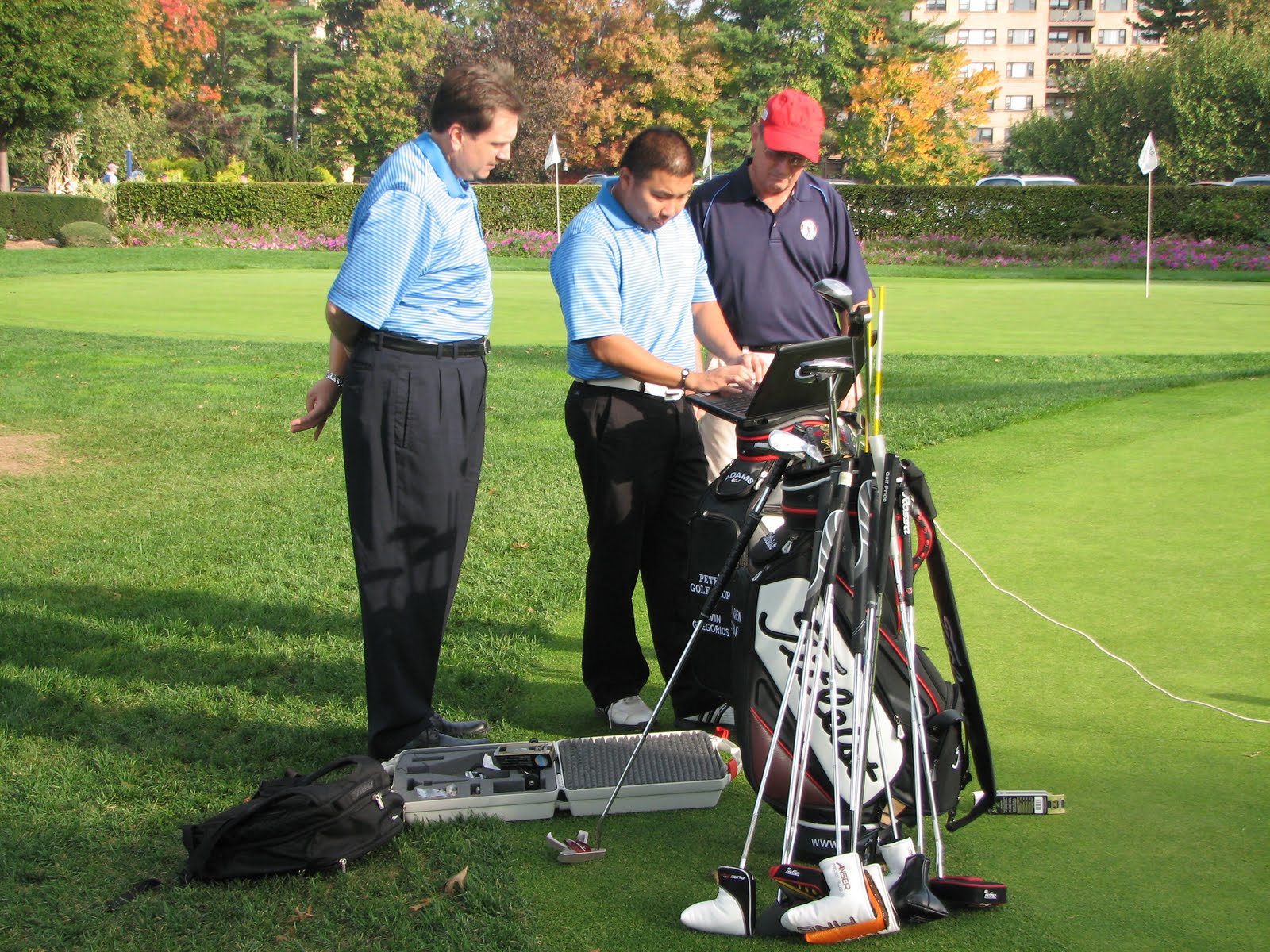
In my endless quest for lower scores (that's why we play this game isn't it?) and not willing to leave well enough alone, I spent some time with club fitters Woody Lashen and Kevin Gregorios from Pete's Golf Shop. The task: measure my putting stroke. The results: my stroke flunked almost all the tests.

Actually, it wasn't all that bad, but I have to say my confidence was pretty shaken after I saw what was really going on when I tried to use what I thought was a pretty effective putting technique. Kevin had me hit five putts--about ten-footers on a pretty straight line--and recorded them using the Science And Motion's PuttLab. The technology uses ultrasound to measure 28 parameters of the stroke.

I won't bore you with all the numbers (mainly because I'm not sure I completely understand some of them), but a few jumped out at me. Here's how my aim looked at setup.


Pretty ugly, huh? I've been told by neutral observers--some of whom snickered as they said it--that I typically address the putt with my shoulders aimed right. I guess I subconsciously compensate by aiming my putter face left, or closed.

Then there's the path my putter follows.


Kind of looks like it follows the direction of my shoulders, doesn't it? If this was all I'd seen, I might have tossed my clubs in the lake and retired to the chess board or some other game where aim doesn't matter. But then Kevin showed me what my putter face looked like at impact.


Now that's encouraging. My putting stroke may look like Jim Furyk's full swing--once described as an octopus trying to change clothes in a phone booth--but it puts the putter face squarely behind the ball at the moment of impact when it counts.

One thing I found that really surprised me, though, was the amount of loft I was adding to the putter with my stroke.


This was a real shocker because I've been working hard lately on doing just the opposite. I read Dave Stockton's book on putting and had just delved into Michael Breed's new book (reviews to come) and thought I was de-lofting the putter with a forward press. Guess not.

Of course, there were loads of other data in the report Kevin sent me after the session. He also measured the swing path, loft and rise of the club, the timing of my swing, and its dynamics (remember that octopus analogy?) as well as where on the putter face the ball made contact. It was all very helpful and I hope to spend more time with the system someday.

In addition to writing about golf, Dave Donelson distills the experiences of hundreds of entrepreneurs into practical advice for small business owners and managers in the Dynamic Manager's Guides, a series of how-to books about marketing and advertising, sales techniques, motivating personnel, financial management, and business strategy.

Tuesday, September 20, 2011

My Numbers Show The Power Of Club Fitting

Distance? You want distance? Get yourself to a competent club fitter immediately. I spent a couple of hours on the fitting tee with Steve Kurnit at DD Custom Golf, a new club fitting service operating at Fairview Golf Center in Elmsford, yesterday and saw some numbers that made my jaw drop. How about another 20 yards on my drives and ten more yards with my irons? Those numbers aren't to be sneezed at.

Steve started with a complete analysis of the clubs in my bag today. FYI, my driver is about five years old--and I was fitted for it at the time by a good, experienced club fitter. My irons have been around for three years and were fitted to me by the company rep, so these weren't off-the-rack junk either. I've also not been unhappy with the results I was getting--at least until Steve took me to the top of the mountain and showed me what kinds of shots I could hit.

My current driver distance is about average for a slightly better than mediocre player: according to the monitor, I carry it 226 yards and it runs out to a total distance of 254 yards. On this day, at least, I also hit it only about a yard off line. Then Steve started tinkering (mostly switching shafts) until he put one in my hands that carried 243 yards and produced total distance of 273 yards--with just a slight increase in distance off the center line. Maybe it's not tour length, but it's longer than I ever expected to hit the ball.

Then we went to my six iron. The current club carries 167 yards with a peak height of 27 yards and produces total distance of 185 yards. By the time Steve got done testing different configurations, I was hitting a six iron 175 yards in the air with another 20 yards of run out for total distance of 195 yards. That particular club didn't have quite as much height in the ball flight, though, (peak height of 20 yards) so he made up another one that carried almost as far--172 yards--at a peak height of 26 yards for total distance of 192 yards. All without tinkering with my swing!

Think about these numbers for a minute. If I'm playing a 450-yard par four now, it takes a 250-yard tee shot followed by a hybrid or even fairway wood to reach the green in regulation. If I arm myself with clubs made to Steve's specs, I'll be hitting a seven or eight iron into that green. Gee, you think my scores might go down?

BTW, I interviewed Steve not long after he opened shop in Elmsford. He explained the procedures he follows in an earlier post.

In addition to writing about golf, Dave Donelson distills the experiences of hundreds of entrepreneurs into practical advice for small business owners and managers in the Dynamic Manager's Guides, a series of how-to books about marketing and advertising, sales techniques, motivating personnel, financial management, and business strategy.

Tuesday, July 5, 2011

Even If Your Clubs Are Off The Shelf--Get Fitted!

Golfers will find the best of both worlds at DD Custom Golf, a new club fitting service operating at Fairview Golf Center in Elmsford. Owner Steve Kurnit, a club fitter of long-time good standing in the metro area, not only offers high-tech measurement, but you can see what's happening with your ball flight as he tweaks your clubs on the range.

"The flight monitor only watches the ball for 15 inches," Kurnit points out, "but having the range lets the client see how the ball really behaves."

Kurnit estimates he's done 1500 fittings since he started in the business 25 years ago. He set up shop in partnership with Fairview just a few days ago. He not only has all the tools to measure your swing there, but a shop on the premises to tweak your sticks on the spot, too. The shop is only a few steps away from the privately-curtained hitting bay he uses to check your swing.

In addition to measuring the golfer's lie, loft, and shaft length, Kurnit emphasizes the importance of having the right shaft flex for your swing. "You hit the ball with the head, but you hit it right because of the shaft," he says. It's also not enough to pick the right shaft according to the manufacturer's specs, either, since any one graphite shaft in a supposedly identical group of ten can vary as much as a full flex from the others. If you're going to spend $300 on the perfect shaft, he emphasizes, you should have it tuned to be sure you're getting what you want.

Kurtin uses a GC2 Foresight flight monitor to check swing speed, ball speed, launch angle, shaft angle at impact, back spin, side spin, percent off line, carry, roll, and peak height. Since the golfer is hitting on a full range, he or she can see what all those numbers really add up to.

I'm a big believer in proper club fitting and can personally attest to one of Kurtin's points: most players will hit their driver further and straighter if they use a shaft shorter than the standard 46 inches. "It's all about controlling the club face so it strikes the ball in the center," Kurtin says. "Center hits on square club faces have less spin so they fly straighter." Even if your clubhead speed is a little shower, it's axiomatic that balls that land in the fairway run out more than those that hit the rough.

A full 14-club fitting can run three to five hours in total (not all at once!) and runs $275. Each driver, fairway wood, and hybrid are individually measured, as are all the irons and even your putter. Irons or woods only are $150. A great way to try out the service is with a one-club "quick fit" for $75. Take your driver--and see what a shorter shaft will mean to you.

DD Custom Golf is at Fairview Golf Center in Elmsford. For more information, call (914) 715-8486. By the way, the "DD" in the name doesn't stand for Dave Donelson--it's "Dynamic Diagnostic" Custom Fitting.

In addition to writing about golf, Dave Donelson distills the experiences of hundreds of entrepreneurs into practical advice for small business owners and managers in the Dynamic Manager's Guides, a series of how-to books about marketing and advertising, sales techniques, hiring, firing, and motivating personnel, financial management, and business strategy.

Tuesday, May 27, 2008

Hot Stix Fix

I’ve always suspected it, but now I know—my golf clubs are costing me strokes. Yes, despite the oft-heard adage that it’s the carpenter, not the hammer, who bends the nail, I now have confirmation that my clubs are responsible for at least some of my errant shots.

The truth was confirmed by a trip to Hot Stix Golf Performance Center at the Doral Arrowwood in Rye Brook, NY. I took my irons in for a check-up and was shocked by what Steve Grosz and Chris Marsh found when they put the clubs to the test. Then I was delighted by what they did to fix them. My irons, by the way, are Ping i-3’s that were fitted to me four years ago and seemed to work just fine at the time. But that was then and this is now and, despite a better swing thanks to many lessons and much practice, my approach shots seemed to be getting more and more erratic.

Hot Stix club fittingIt turns out that at least part of the problem is the clubs. Grosz explained that, once the basic lie angle is determined by your body and your swing (which is what used to happen during a normal fitting), each one of a matched set of irons should have progressively shorter shafts (by a half-inch each) and a one-half degree more upright lie angle. When they measured my irons, some of them were as much as three times more upright than they should be.

Does it matter? Only if you want to hit greens in regulation. Each degree an eight iron is off, for example, sends a 150-yard shot 15 feet off-line unless your swing somehow compensates for it. As you can imagine, it’s almost impossible to consciously or sub-consciously adjust every swing if the clubs aren’t right. So what’s the big deal about 15 feet? If the hole is cut five paces from the edge of the green (which would be a generous position), your approach is going to land somewhere other than the putting surface.

Grosz and Marsh measured all my irons and reset the lie angles. Now the same swing should produce the same line with each club—assuming I swing the same way twice. Considering that my pitching wedge was a whopping 1.5 degrees off, I expect to be looking at a lot more birdie putts instead of hoping for a sand save.

This is just one facet of the complete testing and fitting service Hot Stix provides. They also measure the ideal loft and shaft frequency for your irons (and woods) and determine the proper weight and bounce for each of your wedges. If you want, they’ll also apply their technological skill to your putting stroke, measuring impact, launch angle, skid, follow-through, and consistency. Services are available individually (an iron fitting lasts about 90 minutes and costs about $200), or you can go the whole route and get a “Tour fitting” that includes a session on the course where the experts will observe your swing under varying conditions. That lasts four to six hours.

The biggest single advantage Hot Stix offers, in my opinion, is that all testing is done outdoors on a full range, so the GPS and vector analysis is complimented by seeing the actual ball flight. I think I swing differently outdoors than I do in a testing booth, too.

Dave Donelson, author of Heart of Diamonds a about in the

Thursday, April 3, 2008

A Fitting Encounter

Playing golf with off-the-rack clubs is akin to chewing a steak with store-bought teeth. You can do it, but the experience is far from optimal. Fortunately, just as there are plenty of specialists to properly fit new choppers to your mouth, there are numerous places in Westchester to get measured for perfectly fit golf clubs.

There are three basic ways to go. One is to a golf retailer, where a salesperson will use several devices to make sure the sticks you buy match the peculiarities of your swing the way a tailor will match your 30-inch inseam to your 42-inch waist. The second is to the golf club pro shop, where a PGA professional will lend his or her considerable expertise to the process. The last is to a club fitting service, where the technician will measure most of the moving and some of the non-moving parts of your golf swing, your anatomy, and maybe even your psyche. They use radar, lasers, ultra-high-speed cameras, strobe lights—you name it, they measure it. Then they feed it into their computer and come back with a profile of what happens when you swing a club at a golf ball.

My first experience with high-tech club fitting was with Rick DeMane, a third-generation golf technologist located in Greenwich, CT. It was fascinating to hit the ball in his studio surrounded by mysterious gizmos, then take a peek at the instantaneous feedback that explained in excruciating computerized detail why my last swing looked like something spectators should wear helmets to watch. After I tried out several drivers, he modified a couple of promising ones to my specs that I then took to the driving range. While the results aren’t Tigeresque, I came away with a club that pounds the ball a respectable distance and even hits the fairway (slightly) more often than not.

It's hard to tell if the results came from increased confidence or the technologically correct implement in my hands, but I've been pretty happy with it either way.

Dave Donelson, author of Heart of Diamonds a about in the