We've Moved


We've Moved!

Dave Donelson Tee To Green has an exciting new home at
Westchester Magazine.

We're still about all things golf, especially those pertinent to golfers in Westchester and the NY Metro, but now we're in a much bigger space!

Please visit our new home at


Showing posts with label Rules of golf. Show all posts

Thursday, November 21, 2013

More Decisions On the Rules of Golf

You've probably heard about the USGA (and R&A) decision regarding video evidence of ball movement, but it's worth noting that they ruling bodies announced 86 other changes to the 2012-2013 edition of “Decisions on the Rules of Golf.” The changes, part of a customary two-year Decisions review cycle, become effective on Jan. 1, 2014.

“The Rules of Golf are constantly evolving,” said Thomas Pagel, USGA senior director of the Rules of Golf. “The Decisions review process is an opportunity for The R&A and the USGA to continue to help make the game more understandable and accessible for players, officials and others who participate in the game.”

To that end, Revised Decision 25-2/0.5 uses pictures to help clarify when a golf ball is considered to be embedded in the ground.

Illustration courtesy of the USGA
Two other changes are particularly noteworthy:

New Decision 14-3/18 confirms that players can access reports on weather conditions on a smartphone during a round without breaching the Rules. Importantly, this new Decision also clarifies that players are permitted to access information on the threat of an impending storm in order to protect their own safety.

Revised Decision 27-2a/1.5 allows a player to go forward up to approximately 50 yards without forfeiting his or her right to go back and play a provisional ball.

If you need some fascinating bedtime reading, printed copies of “The Rules of Golf” and “Decisions on the Rules of Golf, 2014-2015” are available from the USGA and The R&A.

Among many other books, Dave Donelson is the author of Weird Golf: 18 tales of fantastic, horrific, scientifically impossible, and morally reprehensible golf

Tuesday, November 19, 2013

USGA Interprets Video Rule: Don't Believe Everything Your Camera Sees

If a ball moves in the pine straw but nobody saw it except through the lens of a high-def video camera, did it actually move?  Then there's the one about the lonesome tree falling in the forest....

Anyway, the USGA and the R&A have issued a new Decision 18/4. As of 2014, if a ball's movement is "not reasonably discernible" to the naked eye, no violation will be called at the time or later, regardless of whether video evidence exists otherwise.

Just in case you need more detail to understand the new interpretation of the rule, here's the statement the ruling bodies released to explain it:
In recent years, the rapid development of video technology, such as HDTV, digital recording and on-line visual media, has brought a new level of scrutiny to Rules issues arising in elite golf tournaments. This has led to an increasing number of inquiries to officials from television viewers and others about whether a breach of the Rules has occurred, sometimes resulting in breaches of the Rules being identified (and penalties being applied)  after the incident itself occurred. Occasionally, the identification of the breach has been after the player has returned his or her score card, which has therefore resulted in disqualification under Rule 6-6d. These developments have generated considerable discussion concerning whether, how and when such video evidence should be used.
The Rules of Golf Committees of the USGA and The R&A have been reviewing the operation of the Rules in the light of these continuing technological developments in order to determine whether any changes to the Rules are appropriate. In April 2011, the USGA and The R&A adopted Decision 33-7/4.5, which authorizes Committees to waive the disqualification penalty for a breach of Rule 6-6d in narrow circumstances in which the player could not reasonably have been aware of a breach of the Rules that later was identified only through video evidence.
Since adopting Decision 33-7/4.5, the USGA and The R&A have continued to review the impact of video technology on the game. With input and assistance from representatives of the professional tours who serve as consulting members of the Rules of Golf Committees, the USGA and The R&A are now introducing a further modification of the Rules, with effect from January 1, 2014, to address the use of video technology in determining whether a ball at rest has “moved” within the meaning of the Rules. New Decision 18/4 will provide that, where enhanced technological evidence shows that a ball has left its position and come to rest in another location, the ball will not be deemed to have moved if that movement was not reasonably discernible to the naked eye at the time. The Decision ensures that a player is not penalized under Rule 18-2 in circumstances where the fact that the ball had changed location could not reasonably have been seen without the use of enhanced technology.
Beyond these Decisions, as part of the 2016 Rules review,  the Rules of Golf Committees will be discussing other issues concerning the possible effect of video technology on the application of the Rules to the playing of the game, such as the necessary degree of precision in marking, lifting and replacing a ball, the estimation of a reference point for taking relief, and the overall question of the appropriate penalty for returning an incorrect score card where the player was unaware that a penalty had been incurred. As is true of the rules in many other televised sports, adapting to developments in technology and video evidence is an important ongoing topic in making and applying the Rules of Golf. 
In pursuing this continuing review, the USGA and The R&A will be guided by their longstanding position that a Committee should consider all evidence, regardless of the source, that may be relevant in determining the facts to which the Rules must be applied. As reflected in the interpretations contained in the Decisions, for questions of fact, the resolution of doubt must be made in the light of all relevant circumstances and be based on the weight of the evidence. To reach a correct ruling, all evidence from witnesses concerning a possible breach of the Rules should be considered, whether those witnesses are participants in the competition, non-participants such as spectators, or persons who have reviewed television footage and the like. Additionally, the Decisions provide that a Committee may make or revise a ruling at a later time if further information becomes available before the competition has closed.
In many other sports, there are good and understandable reasons for imposing a strict time limit on the review and correction of rules decisions. In golf, however, even at the elite level, players often apply the Rules to themselves without the assistance of a referee and, in stroke play, are responsible for the correctness of the score recorded for each hole. Moreover, competitions are often played over more than one day and, in stroke play, the outcome typically is based on total score, making it possible to correct errors significantly after the fact and, indeed, at any time before the competition is closed by virtue of the result being officially announced. For these reasons, disregarding relevant evidence of a breach of the Rules, obtained before the competition has ended, could lead to uncertainty and to unhealthy debate and disagreement about the fairness of a result that was influenced by an incorrect set of facts and failure to apply the Rules properly. If a player has breached a Rule, but this is not discovered until a later time, whether through video evidence or otherwise, such evidence must be considered so that the correct ruling can be applied and the player’s score can be recorded accurately.
In their ongoing review of the use of video and other enhanced technology, the USGA and The R&A will continue to be guided by the view that, regardless of the timing or the type of evidence used, the integrity of the game is best served by getting the ruling right.
As long-winded as they may be, I dare say I agree with the decision.

Among many other books, Dave Donelson is the author of Weird Golf: 18 tales of fantastic, horrific, scientifically impossible, and morally reprehensible golf

Monday, December 17, 2012

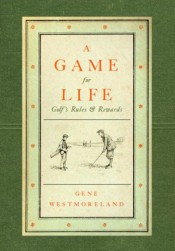
Big Little Book About Golf's Rules And Rewards

Golf: A Game For Life
Gene Westmoreland writes about more than just the rules of golf in A Game For Life, his collection of essays about a subject he knows better than just about anybody.  The book, proceeds of which will be donated to the MGA Foundation, gives us not only insights in the sometimes bewildering rules of the game but also into what makes it one of the best ways to enhance your life.

That may sound like heady stuff, but Westmoreland is anything but a stuffy philosopher. His writing is easy, his approach to the subject is thorough without being pedantic, and his outlook on the game is not so much reverntial as appreciative. He makes a great case for playing by the rules but doesn't hesitate to loosen them up a bit to make the game more fun for duffers just out to enjoy a walk in the sunshine. I've played a round or two with the man, and can attest that his attitude toward the game made every one of them a pleasure.

That attitude carries over into Westmoreland's explanation of the rules of golf, most of which are not only spelled out in clear English but illustrated with incidents many of us have seen either in person or while watching the pros on TV. He does this particularly well in situations that can be rather confusing, like encountering loose obstacles in a hazard. Can you move them? No. Are you penalized if you move, say, a twig in a bunker during your swing? Again, the answer is no. Westmoreland points out, though, that your "swing" doesn't include your backswing! So, if you touch that twig during your takeaway, you've added two strokes to your score. He illustrates the concept by recalling the penalty Brian Davis called on himself during a playoff with Jim Furyk at Harbour Town:
"The TV announcers correctly quoted Rule 13-4, but misunderstood the definition of a stroke, for while it is okay to touch a loose impediment during the stroke, Brian touched it on his backswing."
Nearly every rule examined in A Game For Life has a real-life example that makes it easier to understand and Westmoreland's career in the game has given him thousands of such examples from which to choose. He has been an active member of USGA Championship Committees, serving as co-chairman of the 2004 U.S. Amateur and the 2006 U.S. Open. His service as the Metropolitan Golf Association's Tournament Director for many years (among other accomplishments) led the MGA to christen the trophy for its premiere event, the Met Open, the Westmoreland Cup. In A Game For Life, Gene Westmoreland speaks with both common sense and authority.

Among many other books, Dave Donelson is the author of Weird Golf: 18 tales of fantastic, horrific, scientifically impossible, and morally reprehensible golf

Tuesday, October 25, 2011

USGA and R&A Finally Acknowledge Wind Broke The Rules

The USGA and the R&A finally changed the rules of golf to reflect the reality of playing in windy conditions. Following an exhaustive, four-year review of golf’s 34 playing Rules, nine principal Rules have been amended to improve clarity and ensure penalties are proportionate. The most significant change that will affect most players is one dealing with a ball that moves after a player addresses it:

Ball Moving After Address (Rule 18-2b). A new exception is added which exonerates the player from penalty if their ball moves after it has been addressed when it is known or virtually certain that they did not cause the ball to move. For example, if it is a gust of wind that moves the ball after it has been addressed, there is no penalty and the ball is played from its new position.

Hopefully, this will end situations like the one during the final round of this year’s Open Championship when Northern Ireland’s Rory McIlroy was penalized when his ball was moved on the seventh green by the wind after he had addressed it.

Padraig Harrington, three-time Major winner and R&A-Working for Golf Ambassador, said: “I am delighted with the changes, in particular the ball moving after address. Every time the wind blows I am worried that my ball is going to move and I am worried about grounding my putter, distracting me from trying to hole my putt.

“This change will speed up play, there won’t be as many suspensions and players won’t be getting penalized or disqualified unfairly. It is definitely giving us players a little bit of a break.”

Among the other changes are these:

Ball in Hazard; Prohibited Actions (Rule 13-4). Exception 2 to this Rule is amended to permit a player to smooth sand or soil in a hazard at any time, including before playing from that hazard, provided it is for the sole purpose of caring for the course and Rule 13-2 (improving lie, area of intended stance or swing or line of play) is not breached.

Time of Starting (Rule 6-3a). The rule is amended to provide that the penalty for starting late, but within five minutes of the starting time, is reduced from disqualification to loss of the first hole in match play or two strokes at the first hole in stroke play. Previously this penalty reduction could be introduced as a condition of competition.

Another change is the announcement of publication of a single set of rules with a common cover, something it only took the two groups 60 years to accomplish. Commenting on the revisions to the Rules of Golf, USGA Senior Director of Rules of Golf Thomas Pagel said: “We have produced a unified code of the Rules of Golf for 60 years and although the context has been the same, we often found the perception that there were different Rules in place depending upon where you were to play the game.

“Now the book will not only have the same content, but it will also be presented in a uniform fashion with similar formatting and covers; this will truly be a single code governing the Rules of the game that reflects the strong collaboration between The R&A and USGA.”

There has been a unified code of golf since 1952 but until now The R&A and the USGA have published the same rules in separate editions, thereby giving the impression to some that the rules were different. However, this year sees identical publications with only some spellings and respective logos changing depending whether the edition serves the U.S. and Mexico or the rest of the world.

Golfing legend Arnold Palmer welcomed the announcement of a jointly published edition of the Rules. He said: “What has happened with The R&A and the USGA is wonderful. In the years I have been associated with the game and got to know The R&A and what their efforts are and having lived with the USGA all my life, one of the things I have always thought we should be closer together.”

In addition to writing about golf, Dave Donelson distills the experiences of hundreds of entrepreneurs into practical advice for small business owners and managers in the Dynamic Manager's Guides, a series of how-to books about marketing and advertising, sales techniques, motivating personnel, financial management, and business strategy.

Monday, August 23, 2010

Rules Knock Another Pro Out Of Contention

The rules of golf jumped up and bit another pro in the worst possible place again this weekend when Juli Inkster was disqualified from the LPGA Safeway Classic for using a weighted training aid during her round. The 50-year-old Hall of Famer had suffered through a thirty minute wait on the tenth hole at Ghost Creek at Pumpkin Ridge and slipped a "donut" on her nine iron to loosen up before she hit her tee shot.

NO CAN DO! According to LPGA Director of Tournament Competitions Sue Witters, a TV viewer noticed the infraction and contacted tournament officials. The LPGA checked with the USGA to make sure, but they found no wiggle room so Inkster was told of the DQ when she walked off the course after finishing the round.

Inkster left in a hurry, but later issued a terse statement:
"I had a 30-minute wait and I needed to loosen up," she said. "It had no effect on my game whatsoever, but it is what it is. I'm very disappointed."
Ralph Wimbish of the NY Post provides a few more incidents when tournament outcomes--not to mention golfers' brainwaves--were altered by the rules:
Roberto De Vicenzo — At the 1968 Masters, the Argentinian star carded a birdie 3 on the 17th hole but wrote down a 4 on his scorecard. Because he had signed his scorecard, he did not get into a playoff with Bob Goalby and was left muttering, "What a stupid I am."

Ian Woosnam — At the 2001 British Open, Woosy was in contention until he discovered an extra driver, a 15th club, in his golf bag. Once he realized he had violated Rule 4-4a/6, he gave himself a two-shot penalty, yelled at his caddie and threw the extra driver into a tree.

Craig Stadler — At the 1987 Andy Williams (San Diego) Open, Stadler used a towel to kneel on as he hit a shot from underneth a tree. Several TV viewers phoned NBC to say the Walrus had violated Rule 13-3 for building a stance. Stadler had finished second, but his failure to take a two-shot penalty resulted in a DQ and cost him $37,333 in prize money.

Paul Azinger — At the 1991 Doral Ryder Open, he was on the 18th hole when took his stance in a water hazard and used his left foot to kick away several rocks. A TV viewer from Colarado called the PGA Tour and said Azinger had violated Rule 13-4, subsection 3. Azinger, who shot a 69, was DQ’d for failing to assess a two-shot penalty.

Lee Janzen — At the 1998 NEC World Series of Golf, Janzen hung a putt on the lip of the cup and watched for more than the allotted 10 seconds before it dropped into the cup, a violation of Rule 16-2. His failure to take a 4 instead of 3 resulted in a DQ.

Bobby Jones — At the first round of the 1925 U.S. Open, Jones said his ball moved slightly just before he hit a shot of the rough, a violation of Rule 18-1. He called a one-shot penalty on himself and eventually lost a 36-hole playoff to Willie Macfarlane.

Michelle Wie — She’s been DQ’d for taking an improper drop in her pro debut, penalized at the 2006 British Open for grounding her club in a bunker and DQ’d from the 2008 State Farm when she failed to sign her scorecard. She was in second place when she was DQ’d.
Ah those pesky rules of golf.

Dave Donelson, author of Heart of Diamonds a about in the

Wednesday, June 2, 2010

A Legal Do-Over Putt

Every golfer knows that the second time you hit a putt, it always goes in the hole. Unfortunately, that's not legal....Unless you invoke a little-noticed aspect of Rule 28 of The Rules Of Golf, which covers unplayable lies.

Jeremy McLean, one of the excellent teaching pros at GlenArbor in Bedford, NY, reminds us that a ball can be deemed unplayable at anytime, anywhere on the course except when it lies in a water hazard. What's more, the player is the sole judge of whether or not the ball is unplayable. If you declare it, you have three options, all under penalty of one stroke:

1. Play the ball as near as possible to the spot where where the previous stroke was made.

2. Drop the ball anywhere on a line extending backwards from the point where the ball lay in line with the hole.

3. Drop a ball within two club lengths of the spot the ball lay, not nearer to the hole.

(If you're in a bunker for options 2 and 3, the ball must be dropped in the same bunker.)

Here's where the rule can help your score on the green. Let's say you've got a four-footer above the hole and decide to make an aggressive stroke to keep the ball on line. Unfortunately, the ball lips out and speeds down the hill, leaving you with a thirty-foot comebacker that's not even a cinch two-putt. Or even worse, it runs off the green and down into the fairway even further away! Jeremy reminds us that you can declare the ball unplayable, replace it on the spot above the hole and take your penalty, then have a second chance at that four-footer.

Brilliant!

Thanks for the GlenArbor Teaching Center Newsletter for that excellent rules tip.

Dave Donelson, author of Heart of Diamonds a about in the