We've Moved


We've Moved!

Dave Donelson Tee To Green has an exciting new home at
Westchester Magazine.

We're still about all things golf, especially those pertinent to golfers in Westchester and the NY Metro, but now we're in a much bigger space!

Please visit our new home at


Showing posts with label Golf books. Show all posts

Monday, November 17, 2014

Golf's Best Behavior Manual

Shouts of "Baba Booey" notwithstanding, golf has always been a game remarkable for its civility. The USGA rulebook doesn't cover politeness, however, except in rather general terms. If you've ever not been sure what to do in certain circumstances, you need a new booklet called "Golf Etiquette Quick Reference. A Golfer's Guide to Correct Conduct." by Yves C. Ton-That, a rules official and best selling golf author.

This new pocket-sized guide supplements "Golf Rules Quick Reference", Ton-That's first guide that sold more than one million copies and is the best selling golf book in the U.S. It has been translated into more than twenty languages and according to Golf Digest is "the best effort yet to decipher the Rules of Golf." The new booklet covers everything golfers of all skill levels need to know, so that you can play any course in the world with confidence. It includes sections on topics like preparing for the round at home and enjoying a drink at the 19th hole as well as safety, courtesy, and fixing divots. The guide is also extensively illustrated in color and is the perfect complement to the Golf Rules Quick Reference.

"Etiquette on and around the golf course is crucial, and is just as important as the rules of play to ensure that you play the game in the proper spirit," says Ton-That, who also penned "Trouble Shots and Quick Fix Guide" in his career as an author. "When you're in the company of seasoned golfers, or invited to play a private club, saying or doing even one thing incorrectly can make the difference of not being invited back. And with a little preparation and knowledge, you can avoid most any potentially embarrassing situation."

The 48-page, spiral-bound and plastic-coated book is now available in golf shops and at www.golfrulesmadeeasy.com, for $12.95 (ISBN 978-3-909596-77-5, Artigo Publishing International, 1st edition 2014).

Among many other books, Dave Donelson is the author of Weird Golf: 18 tales of fantastic, horrific, scientifically impossible, and morally reprehensible golf

Thursday, July 10, 2014

Steinbreder's 18 Ways to Play Better


If you want to play better golf, your first stop should be at the lesson tee with a PGA professional.  To find out just how good these guys are--as teachers--check out John Steinbreder's 18 Ways to Play a Better 18 Holes.  The veteran golf journalist got eighteen of the best PGA pros to talk about their approach to various aspects of the game and the results are exceptional, no-nonsense nuggets of wisdom just like they would convey to you on the lesson tee.

The list of PGA pros in this book reads like a who's who of America's best golf teachers at America's best country clubs.  It includes Bob Ford from Oakmont and Seminole, Darrell Kestner (Deepdale), Scott Nye (Merion), Eden Foster (Maidstone), and Brian Crowell (GlenArbor).  Topics covered range from sound basics like driving, putting, and bunker play to strategies for competition, fitness, and course management.  Suzy Whaley (TPC River Highlands) even gives a lesson on taking a lesson!

The lessons are based on Steinbreder's interviews with the pros, who were given a chance to read and correct the entries before the final version was published along with a scattering of illustrative photos.  The result is eminently readable and will serve every golfer well.

Among many other books, Dave Donelson is the author of Weird Golf: 18 tales of fantastic, horrific, scientifically impossible, and morally reprehensible golf

Monday, May 5, 2014

Bio of Trent Jones, Warts and All

Some of my favorite golf courses were designed by Robert Trent Jones, Sr., but that's not why I consider the story of his life written by James R. Hansen, A Difficult Par, one of the best biographies I've read in a long, long time. What I really enjoyed about the book was the totally unvarnished view it presents of the man's life and accomplishments, good, bad, and otherwise. Quite frankly, most golf biographies are hagiographies barely worth the effort it takes to turn the pages. This one I couldn't put down.

Robert Trent Jones, Sr., may well have been the most influential golf course architect of the game's flowering in the second half of the twentieth century. He was an English immigrant who arrived in the U.S. just as golf was on the verge of becoming a popular past time. His up-by-the bootstraps early life is a prelude to the ego-driven success he enjoyed as the premier designer of his day. As Hansen presents him, Jones was a brilliant architect and a shameless self-promoter. The interplay between the two sides of the man gives the reader rare insight into his spectacularly successful career.

Hansen gives excellent descriptions of everything from the design concepts to the political and financial relationships behind most of the top courses Jones created and renovated, which makes for fascinating reading for golfer and non-golfer alike. His renovation work at Augusta National, the National Golf Links, and Winged Foot, for example, may have been lost with the passage of time, but was important in the history of the game. Many of his post-war original designs are atop every aficionado's "best of" list: Dunes Club in Myrtle Beach, Hazeltine, Spyglass, not to mention the Robert Trent Jones Trail of excellent courses across the state of Alabama.

Golfers in my neck of the world are probably aware of the many contributions Jones made to the quality of the game in the Northeast, particularly in New York, but may not realize how much of that came in the form of public, daily fee courses.  Among them are Montauk Downs, Eisenhower Park's White and Blue courses, Marine Park, Bruce Memorial in Greenwich, and Casperkill in Poughkeepsie (originally built for IBM).

Hansen also explores the failures as well as the fabulous successes in Jones's career, many of which illustrated the man's weaknesses as a businessman instead of his strengths as an architect. He pulls no punches when it comes to the less-than-savory history of Jones's relationships with some partners and collaborators both early and late in his career. The complicated relationship between and among Jones and his two sons, Robert Trent Jones, Jr., and Rees Jones, gets full play, too, although in a perfectly respectful manner. The book doesn't drag anybody through the mud, but the author doesn't hesitate to show you the puddles along the way.

In many ways, A Difficult Par resembles Jones's favorite design concept: a good golf hole is an easy bogey but a difficult par. It moves along as an easy read with plenty of drama and entertainment value. If you want to dig deeper, however, the well-researched history Hansen presents is well worth careful, studious consideration.

Among many other books, Dave Donelson is the author of Weird Golf: 18 tales of fantastic, horrific, scientifically impossible, and morally reprehensible golf

Wednesday, April 16, 2014

Sandy Tatum Words to Live Golf By

Sandy Tatum's aptly-titled memoir, A Love Affair with the Game, is a collection of the former USGA President's memos, columns, correspondence, and just plain random thoughts about the game converted into a gentlemanly thought-provoking book. Historians of the game may be disappointed that it's not a blow-by-blow description of his career at the highest reaches of amateur golf, but readers who recognize that golf is more than millionaire tour players adding to their pile on Sunday afternoons will recognize a kindred spirit.

Tatum spends a little time talking about how he got into the game and what he accomplished as a young amateur--including winning the 1942 individual NCAA National Championship while graduating Phi Beta Kappa from Stanford University and winning the Danish Amateur while studying at Oxford University as a Rhodes Scholar. The bulk of the book, though, consists of short essays about the people and places he's encountered--good and bad--during sixty years in the game.

I was particularly impressed by Tatum's never-sent letter to Tiger Woods. It was written at the time just before Tiger turned pro, dropping out of Stanford in the process to fully cash in on his prodigious talent. For those who believe accumulating a pile of money is the highest purpose in life, Tatum's comments will come off as sanctimonious bulls--t.  If, like me, you believe our time on this planet can be richer if we look beyond our bank statements, you'll appreciate what Tatum had to say. He pointed out that Woods would benefit greatly from a complete education, as anyone who has heard him speak in anything more than soundbites knows is very true. The other point he made is that Woods was setting a horrible example for other young people tempted to throw away their lives to chase the one-in-a-million chance of succeeding in professional sports. The letter, written in 1996, was sadly prophetic. There is more to life than video games and hookers.

Sandy Tatum may personify the stereotypical USGA "blue jacket" to some, his rectitude is refreshing in a time when golf seems to have degenerated into a contest to see who can land the biggest television contract.

Among many other books, Dave Donelson is the author of Weird Golf: 18 tales of fantastic, horrific, scientifically impossible, and morally reprehensible golf

Sunday, April 6, 2014

Remembering How Fred Raphael Shaped Golf Television

One man--who wasn't even much of a golfer--created two of the most influential series in the televising of the sport. He was Fred Raphael, and his book, My Mulligan to Golf, tells the often-hilarious story of how he brought us Shell's Wonderful World of Golf and the origins of the Champions Tour.  It's golf history with numerous amusing twists.

For those of us who've been following the game for a few years, Shell's Wonderful World of Golf was a delightful look into the personalities and games of the best golfers in the world playing in matches on the best golf courses around the globe. The first telecast was a match between Gene Littler and Byron Nelson at Pine Valley--how much better do you want? It was followed by shows featuring Ben Hogan, Sam Snead, Tony Lema, Roberto DeVicenzo, and many, many others. The hosts, Gene Sarazen and Jimmy Demaret, were insightful, funny, and worth the price of admission by themselves.

The story of how Raphael came to put the show on TV despite the fact that he was a neophyte in the game is full of fascinating anecdotes, improbable occurrences, and delightfully off-beat commentary. It gives the reader a good look not only at golf, but behind the scenes of sports television as well. As a former broadcaster, I found that aspect of the book as interesting (almost) as the stories about the world famous golfers and their performances.

Raphael also gave birth to the Liberty Mutual Legends of Golf Tournament, which in turn begat the Senior Tour (now the Champions Tour). How many millions of dollars have been earned by touring pros who extended their playing careers as a result? More importantly, how many millions of golf fans have had the opportunity to see the greats of the game in action because of Raphael's concept? It's a story well worth reading.

Among many other books, Dave Donelson is the author of Weird Golf: 18 tales of fantastic, horrific, scientifically impossible, and morally reprehensible golf

Sunday, March 16, 2014

Golf By the Numbers, Numbers, and More Numbers

Should you go for the green or lay up? Putt aggressively or die the ball into the hole? Who scores better, a good driver or a good putter? Quantitative researcher Mark Broadie, a professor at Columbia Business School, member of the USGA handicap research team, and former club champion at Pelham CC, applied the same rigorous statistical methods used by Wall Street’s quants to the game of golf to find the answers to these and other major questions of golf strategy.  You’ll be surprised at the answers as he reports them in Every Shot Counts.

Even though there is a foreword by Sean Foley, this is NOT a book about how to swing a golf club.

It is rather an extremely detailed analysis of the game using a measure Broadie developed, "strokes gained." You may have heard the term used on PGA telecasts, particularly in the context of "strokes gained putting," but Broadie has expanded the concept to cover nearly aspect of golf using data from the PGA Tour's ShotLink database as well as one he developed to gather similar data for amateurs, the Golfmetrics system. The result is about as easy to read as a set of IRS instructions, but just like slogging through the tax code, if you stick with it, it will pay off.

I won't go into all the details of how he reached his conclusions, but suffice it to say Broadie convinced me that many of the "truths" about golf I heard and believed for decades are just flat wrong. "Drive for show--putt for dough," for example. WRONG! Broadie's analysis shows that tee shots account for 28% of the shots gained in a round as opposed to putting's mere 17%.

How can that be, you might ask, if putts represent about 50% of your strokes in a round? The answer is that Broadie is comparing performance to the field of golfers, not to par. If you're playing competitive golf, whether on Tour or against your buddies at your local muni, your score relative to theirs will be more strongly affected by your driving than your putting.

That's not the real surprise, though. Broadie's most important conclusion is that the approach shot--not your drive, not your putts, not even your dazzling wedge play--is the most important factor in the game when it comes to beating your opponents. The approach accounts for a whopping 40% of the strokes gained on the field.

Add in the drive, and 68% of the strokes gained can be traced to the long game. This is based, by the way, on his stroke-by-stroke analysis of the top 40 pros during the 2004-2012 seasons.  Interestingly enough, Broadie's research shows that the same ratios hold for amateurs at every level, too!
"Contrary to popular belief, this research proves that the long game explains two-thirds of the difference in scores between beginning and skilled amateurs, between amateurs and pros, and between average pros and the best pros. Academics call this a robust result: It holds for many different groups of golfers. It's the closest thing to a universal truth in golf."
Laying up to a full-swing wedge distance is another truism that Broadie proves is a "falsism."  Haven't we all been taught that the key to a good lay up is to not necessarily hit it as close to the green as you can but rather to a distance where you can take a full swing with your favorite wedge?  Here's what Broadie's research revealed:
"...most golfers will score worse from 80 yards from the hole than from 30, even if every layup to 30 yards lands in the rough, and every layup to 80 yards lands in the fairway."
Actually, I've been a believer in taking my chances with a half-wedge for several years, but felt like I was violating some rule or something every time I did it. Now I know I have been right all along--and the feeling is excellent.

If you can slog through the numbers, Every Shot Counts may well change the way you think about your game.  Broadie spends a good portion of the book applying his analysis to strategic choices like where to aim when there's out-of-bounds on the hole and how to read and putt greens. He's got a section on drills, too, although some are perhaps not for the math-impaired.

Even if you need to take off your socks to calculate your winnings on a round-robin Nassau with three presses, you'd be well-advised to spend some time working on your game with Broadie's numbers in mind.

Among many other books, Dave Donelson is the author of Weird Golf: 18 tales of fantastic, horrific, scientifically impossible, and morally reprehensible golf

Thursday, January 30, 2014

Old Tom Morris Golf Shop Located at St. Andrews

The location of Tom Morris’ first golf shop has been discovered in manuscripts from the Golf Collection in The University of St. Andrews Special Collections Department. Local golf history writer Roger McStravick, who was carrying out research for a book on the man known as the ‘Grand Old Man of Golf,’ discovered a statement known as a precognition given by Tom Morris himself around 1878 detailing how he built in that same year his own shop beside the St. Andrews Links at what is today 15 The Links.

Dr. Anthony Parker, Curator of the Golf Collection at The University of St. Andrews, stated, “We are all very excited by this find.  The University has a vast golf collection going back centuries and this news of Tom Morris’ first shop is very likely to be the first of many new findings to come out of the collection.”

Roger McStravick (right) and Anthony Parker (left)
“There has always been a gap in Old Tom’s story from 1848 to 1851, before he left St. Andrews to create the course at Prestwick,” McStravick said. “In a pile of very old papers, I noticed a statement from Tom amongst the precognitions taken at the time of the Road Wars, when the town was trying to decide whether to have a road along the side the 18th hole of the St. Andrews Links. In his statement talking about his life around 1848, Tom says that he built his own shop and through statements by others at the time, including the father of the R&A John Whyte-Melville and club maker Robert Forgan, I was able to identify the exact location for this little shop at what is today 15 The Links. I was also delighted to discover from the same precognitions that Daw Anderson, who is known as the ginger beer seller, had his own golf shop at 9 The Links with his son and three time Open champion Jamie Anderson living upstairs for almost 10 years during his Open winning days. Daw was so much more than just a ginger beer seller and thanks to the University’s archives his true story is beginning to emerge.”

Mrs. Sheila Walker, a great-granddaughter to Tom Morris, welcomed the news saying, “There has been a lot of study around my great-grandfather and it is always very exciting when new finds are discovered. Roger is to be commended for his work and, importantly, this highlights just how essential the University’s golf collection is to golf historians and to the field of golf research. I understand the University has ambitions to create a dedicated centre for golf-related materials in St. Andrews and this recent finding is proof, if proof were needed, how vital and appropriate it is to have the centre of all golf knowledge in St. Andrews.  If there was ever a logical place to establish an academic centre for golf in the world, then it is surely here.”

Mr. Peter Crabtree, co-author of Tom Morris of St. Andrews: The Colossus of Golf, 1821-1908, also heralded the find saying, “I am always delighted when new research reveals more about Tom Morris. He was a rare character who in addition to being a four time Open champion, helped create the Old Course in St. Andrews as we know it today. The front nine is virtually his own work under the auspices of the R&A Green Committee. We owe so much to Tom Morris and I am delighted the location for his very first shop, at what was a crucial moment in his life, has been discovered.”

“My book would not have been written or the research carried out, if it wasn’t for Peter Crabtree and the late Dr. David Malcolm’s inspirational book on Old Tom, plus the work of David Joy and in particular his portrayal of the great man,” commented McStravick.  “It was his re-telling of Tommy’s story during a performance of Old Tom Morris at The Byre Theatre that struck a chord with me and ultimately led me to this finding.  Without their work, I would not have made this discovery.”

Regarding the Centre for Golf Collections, Dr. Anthony Parker added, “This new research by Roger is a shining example of what can be achieved from the University’s collection. The University’s hopes for a purpose built Special Collections facility to host its golf collection has caught on with many of the greatest golf collectors and organisations around the world donating rare books, photos and written material already. We are currently engaging in consultation with a wide number of bodies about our aspirations.’

Among many other books, Dave Donelson is the author of Weird Golf: 18 tales of fantastic, horrific, scientifically impossible, and morally reprehensible golf

Tuesday, November 19, 2013

Winterizing With Mike Diffley

Some words of winter wisdom from guest blogger Mike Diffley, head pro at Pelham CC...

Hope everyone is catching some rest after a long beautiful fall here in the Northeast! It's great to have the seasons here in the Met area. Spring brings excitement, the Final Four, the Masters and the start of the golf season. Summer brings long days with plenty of opportunity to get outside and enjoy ourselves. Fall is an awesome time for golfers, conditions are great, the weather outrageous and the end of the season coming soon. Too soon sometimes but still it is great to have a beginning, middle and end.

Those of you that are not in the golf industry, I know you don't get enough time. Weekends seem to fly by even when you get to recreate a little. In the golf business, yes we work almost every day but it is our profession and we live and breathe what we do, so lucky us! Now for the winter, which totally sucks. And I hate the end of daylight savings time--I feel like someone hit me in the forehead with a brick! It is a time to rest, regroup, re-set goals and work on some things that will make us better and healthier.

So are you setting an off-season or winter list of goals? You should! I am!

Physical - You can become more fit ( flexibility and strength are the keys ) The purpose is to be stronger and to increase your club head speed. My favorites are stretching, plenty of places to learn that (Titleist Performance Institute Channel on YouTube) and using the Swing Fan and Swoosh. The Fan provides resistance like weight training and the Swoosh provides speed training. Modern sports science says both are needed to improve your swing speed. Do 2 sets of 10 each working your way up to 25 of each. A little cardio, I ride a bike (something to get you sweating).

Putting - Get a putting mat  (8 feet is enough) do sets of five or ten and make 50 or 100 total. To mix it up make 50 at three feet and then go and make 50 at six. I would do one set standard, one set looking at the hole, one set with your eyes closed, one set left hand only, and one set right hand only!

Mental Training - Read a book!  Here are a few that will stretch your brain and you might learn something about getting better at golf and more!

The Practicing Mind - Thomas M. Sterner (How learning golf is like learning music with deliberate Practice!)
Mindfulness - Ellen J. Langer (The opposite of mindlessness!!  Enough said)
High Performance Golf - Henry Brunton (Many aspects of getting better and developing golfers)

I'm going to Jupiter in a week or so to spend the winter. I'll be playing, coaching and enjoying the golfer life! Lucky me! I'll be starting off with helping Nannette Hill get through LPGA Q School. She is injury free and looks ready to me. Then on to Fox Club in Stuart working on my game and helping those who think I can!

If anyone wants to find me, this is a good avenue to track me down. Be well. Go Johnnies!

Among many other books, Dave Donelson is the author of Weird Golf: 18 tales of fantastic, horrific, scientifically impossible, and morally reprehensible golf

Tuesday, August 6, 2013

Jim McLean Helps You Drill Like A Pro

Few instructors have seen more swings and given more solid lessons--to amateurs and top pros alike--than Jim McLean. Now, his decades of experience are distilled into 120 drills that will help every aspect of your game in Golf Digest's Ultimate Drill Book.

The book covers the complete game from stance, grip, alignment, and posture to the full swing with every club from driver to putter. McLean also has some excellent drills to build your stamina and flexibility as well as a few to sharpen your mental game--something many instructors talk about but only a few, like McLean, offer any practical help with.  All the drills are described in a four-part format: Problem, Result, Goal, and Practice Procedure. There are plenty of annotated photos to illustrate each one.

I recognized several of the drills from the time I spent at McLean's school at the Doral, but I also found many fresh ones, too. One of my favorites is the Right-Arm-Only On-Center Drill, which teaches how to co-ordinate body and arm action. It's also one (of several) you can do on the tee while you're awaiting your turn to hit. I also particularly like the Pacific Ocean Drill, where the player imagines hitting balls at a target the size of the ocean in order to encourage a free swing unencumbered by attempts to steer the ball.

McLean is one of the game's greatest teachers. You may not be able to make it to one of his schools, but you can benefit from his wisdom with this simple, thorough instruction book.

Among many other books, Dave Donelson is the author of Weird Golf: 18 tales of fantastic, horrific, scientifically impossible, and morally reprehensible golf

Saturday, July 27, 2013

Re-Live The War By The Shore

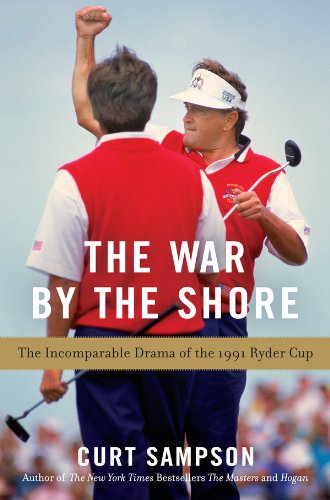
The Ryder Cup packs more excitement into the game than any event in golf. Curt Sampson captured all that excitement and then some in The War By The Shore: the Incomparable Drama of the 1991 Ryder Cup. His immensely readable account explores all the intrigue leading up to the event, all the out-sized personalities who played in it, and especially the sheer brutality of the ultimate Ryder Cup venue, Pete Dye's Ocean Course at Kiawah Island.

The intensity of Raymond Floyd, the almost physical clashes between Paul Azinger and Seve Balesteros, the crushing collapse by Mark Calcaveccia, the often-overlooked performance of David Feherty, the ever-so-tightly-wound play of Bernhard Langer that lead to the climactic last putt--Sampson brings it all home to the reader in a delightfully entertaining, informed account. He talked to nearly everyone involved in the event and, although the passage of time may have obscured a few details and more than a few axes are still being ground, he did an exemplary job of telling us what was happening in their heads as well as on the course.

The stories are well known, but Sampson makes them come alive with refreshingly cliche-free prose. As a golf writer myself, I particularly appreciate his ability to set the scene, describe the characters, and carry the reader through the action with original verbiage you'll never (unfortunately) see on the sports pages.

The 1991 Ryder Cup is often cited as a turning point in the long history of the event. Sampson takes some issue with that conclusion and I agree with him. There is no question, though, that the War By The Shore woke up America to the powerful spectacle that team golf can be.

Among many other books, Dave Donelson is the author of Weird Golf: 18 tales of fantastic, horrific, scientifically impossible, and morally reprehensible golf

Thursday, July 11, 2013

Sweetspot Captures the Golf Obsession

Golf is a sport, a gentle pastime, an innocent game. But for Tom, the protagonist of John O'Hern's novel Sweetspot: Confessions of a Golfaholic, golf is an obsession, a sickness, a life-altering addiction that wrecks his career and nearly destroys his marriage--all in a comedic way. Those of us immersed in the game will recognize the symptoms. Hopefully, like O'Hern, we can laugh at them.

Sweetspot is an outrageous take on all things golf, from the way an accidentally perfect shot makes us go weak in the knees to the ridiculous lies we tell our wives and bosses to cover up the quick nine we played that afternoon when we were supposed to be visiting customers. There's a sleazy womanizing club pro, a bunch of play-at-every-opportunity obsessives, and several long-suffering golf widows including especially Tom's wife Carol. Golfers will recognize them and get a laugh or two out of their shenanigans on and off the course.

O'Hern plays the foibles of the game for all they are worth. He stretches a few golf customs for comedic effect or to move the plot along, which is fine by me: after all, I wrote a short story about Superman and Batman playing a grudge match at Pebble Beach in my book, Weird Golf. About the only problem I had with the novel was O'Hern's choice of Ben Hogan as the evil spirit that guides Tom down the path to perdition. Given Hogan's reputation, that just doesn't ring true.

Sweetspot is a fun, easy read that should appeal to non-golfers as well as those of us obsessed with the game.

Among many other books, Dave Donelson is the author of Weird Golf: 18 tales of fantastic, horrific, scientifically impossible, and morally reprehensible golf
Friday, May 3, 2013

Make Every Putt?

Like every golfer, I've been waiting my entire life for this book: How to Make Every Putt: The Secret to Winning Golf's Game Within the Game, by Dr. Joseph Parent. If it delivers on the title, this book is worth a fortune to every golfer in the world.

And it does, if you accept Parent's definition of "making a putt." The book focuses on the mental and physical challenges of putting, building on the author's previous book on the subject, Zen Putting. As you might expect, while there are plenty of drills and practical  hands-on advice, much of the book is about how you think--or preferably don't think--about your putting stroke.  That all relates to the author's definition of "making" a putt, which he says is, "The ball starting out on the line you chose, at the speed you wanted, with what you felt was a good stroke."  You may have noticed that there's nothing in that definition about the ball going into the hole.

Parent explains that apparent contradiction by saying, "The secret to making every putt is to focus only on successfully executing your routine and stroke, not letting your concern about the outcome of the putt interfere with how well you're doing that. Take care of your process and let the results take care of themselves."

Putting aside the epistemology of his approach, Parent's book has a wealth of sound advice on how to read greens, judge speed, establish a productive routine, and much more. He also offers a wealth of drills, many of which are made available online through handy QR codes that take you to instructional video clips online. If you're QR-impaired, you can just go to www.zengolf.com to learn more.

Parent has coached hundreds of pros and competitive amateur golfers including Vijay Singh and Cristie Kerr.

Among many other books, Dave Donelson is the author of Weird Golf: 18 tales of fantastic, horrific, scientifically impossible, and morally reprehensible golf

Saturday, March 23, 2013

Grand Slam? You May Not Win It, But You Can Read It -- Free!

Bobby Jones did it, Tiger Woods almost did it, but if the moon were full during the Masters, U.S. Open, British Open, and PGA Championship, could a werewolf win the elusive Grand Slam of golf?

Find out for FREE during this special promotion to celebrate the opening of the golf season in our neck of the woods. Right now you can download a FREE copy of Grand Slam for your Kindle or Kindle app from Amazon.com.

The story is my purely tongue-in-cheek look at the most coveted record in the game. My lupine protagonist stalks the fairways at Augusta National, Shinnecock, Carnoustie, and Winged Foot, not to mention TPC Sawgrass, The Olympic Club, and Whistling Straits, leaving behind a trail of bloody victims and sparking the ire of a golf-obsessed newspaper reporter who vows to stop him.

In case you haven't guessed, this is not your usual golf book! Download it today -- this special promotion ends Wednesday.

Among many other books, Dave Donelson is the author of Weird Golf: 18 tales of fantastic, horrific, scientifically impossible, and morally reprehensible golf

Saturday, March 2, 2013

Caddying At St. Andrews

An American Caddie In St. Andrews
At least once in their life, every golfer should make the pilgrimage to the Old Course in St. Andrews. Oliver Horovitz not only made that trip, he turned it into a coming-of-age book about his experiences working as a caddie there during his college years. An American Caddie in St. Andrews is an enjoyable, light read that covers the young man's summers looping on the Old Course while completing his education at Harvard, chasing girls, and pub crawling through the ancient town.

If you're a golfer looking for hole-by-hole insights into the Old Course, you'll probably be disappointed in this book. On the other hand, if you'd like to know what really goes on in the caddie shack, you'll be rewarded by the many tales Horovitz tells. As most of us have long suspected, caddies don't exactly have positive opinions of their clients. A tip less than 100% of the standard fee is generally met with disdain, for example. The caddies also have a private language for ridiculing their players--often right in front of them--to other caddies. It's not unusual for a caddie to purposely give wrong information to a player just for the sake of having a funny story to tell when they get back to the shack. Basically, two types of golfers are accorded caddie respect: scratch players and celebrities. The former gives the caddie fewer errant balls to look for and the latter gives them something to gossip about.  If you don't fall into either of those categories, according to Horovitz, you're just another chump, at least as far as the caddies at St. Andrews are concerned.

There are some non-golf story elements that turn the book into a memoir of sorts. The author chases girls and catches a few, shares various bachelor-pad type apartments with other caddies, and spends one summer filming the caddies as an assignment for one of his classes at Harvard. He also develops a fond relationship with an elderly uncle who lives in St. Andrews. A recurring theme is the way he was treated by the old caddies at the course and how, over time, he earned their trust and respect.

Among many other books, Dave Donelson is the author of Weird Golf: 18 tales of fantastic, horrific, scientifically impossible, and morally reprehensible golf

Sunday, February 10, 2013

A Book With A Promise - Drive Like The Pros

Drive Like The Pros
As any golfer which he'd rather do, sink a 40-foot putt or pound a 300-yard drive, and there won't be a moment's hesitation. We may putt for dough, but we absolutely love to drive for show, for bragging rights, for the sheer joy of crushing the ball off the tee. If only we could.

Drive Like the Pros promises to make it possible. Unlike many instruction manuals, this one is dedicated solely to driving the ball--everybody's favorite shot.

Mike Neff, an expert in 3-D golf instruction, joined forces on the book with freelance golf writer Dave Allen and examined reams of data gathered by TaylorMade's MAT-T System (Motion Analysis Technology by TaylorMade) to show why our drives don't go as far as those of pros like Dustin Johnson, Sergio Garcia, Sean O'Hair, and Justin Rose. There's probably more data in the book than any of us actually need, but there's no quibbling with the frame-by-frame analysis of good and bad swings or with the suggested drills to correct common flaws.

The detailed descriptions of key points in the swing may be overdone for some readers, but I found it helpful in understanding the concepts Neff was trying to get across. One of the strengths of the book is the use of avatars as well as photos to illustrate key points. The avatars, screen shots from the MAT-T System, are enhanced by color-coded lines that demonstrate the measurements discussed in the text. Take your time, study them together, and you might learn a thing or two about the golf swing.

The first chapter describes the MAT-T System in excruciating detail and could be a turnoff for all but the most dedicated golf gear head, but that's because Drive Like the Pros also serves as TaylorMade's official instruction manual for PGA professionals certified in the MAT-T System. For the rest of us, stick with the book and take your time studying it--the remainder can be quite useful. Neff dissects each stage of the swing from set-up to follow-through. He compares the average over-the-top slash most of us make with the smooth, powerful swing of the pros. The measurements can be a little dense for casual reading, but the book really isn't meant for a quick thumb-through looking for swing tips. It's a serious book for those intent on improving their game.

Among many other books, Dave Donelson is the author of Weird Golf: 18 tales of fantastic, horrific, scientifically impossible, and morally reprehensible golf
Monday, December 17, 2012

Big Little Book About Golf's Rules And Rewards

Golf: A Game For Life
Gene Westmoreland writes about more than just the rules of golf in A Game For Life, his collection of essays about a subject he knows better than just about anybody.  The book, proceeds of which will be donated to the MGA Foundation, gives us not only insights in the sometimes bewildering rules of the game but also into what makes it one of the best ways to enhance your life.

That may sound like heady stuff, but Westmoreland is anything but a stuffy philosopher. His writing is easy, his approach to the subject is thorough without being pedantic, and his outlook on the game is not so much reverntial as appreciative. He makes a great case for playing by the rules but doesn't hesitate to loosen them up a bit to make the game more fun for duffers just out to enjoy a walk in the sunshine. I've played a round or two with the man, and can attest that his attitude toward the game made every one of them a pleasure.

That attitude carries over into Westmoreland's explanation of the rules of golf, most of which are not only spelled out in clear English but illustrated with incidents many of us have seen either in person or while watching the pros on TV. He does this particularly well in situations that can be rather confusing, like encountering loose obstacles in a hazard. Can you move them? No. Are you penalized if you move, say, a twig in a bunker during your swing? Again, the answer is no. Westmoreland points out, though, that your "swing" doesn't include your backswing! So, if you touch that twig during your takeaway, you've added two strokes to your score. He illustrates the concept by recalling the penalty Brian Davis called on himself during a playoff with Jim Furyk at Harbour Town:
"The TV announcers correctly quoted Rule 13-4, but misunderstood the definition of a stroke, for while it is okay to touch a loose impediment during the stroke, Brian touched it on his backswing."
Nearly every rule examined in A Game For Life has a real-life example that makes it easier to understand and Westmoreland's career in the game has given him thousands of such examples from which to choose. He has been an active member of USGA Championship Committees, serving as co-chairman of the 2004 U.S. Amateur and the 2006 U.S. Open. His service as the Metropolitan Golf Association's Tournament Director for many years (among other accomplishments) led the MGA to christen the trophy for its premiere event, the Met Open, the Westmoreland Cup. In A Game For Life, Gene Westmoreland speaks with both common sense and authority.

Among many other books, Dave Donelson is the author of Weird Golf: 18 tales of fantastic, horrific, scientifically impossible, and morally reprehensible golf

Monday, October 15, 2012

Pelz Plays Games

Dave Pelz Putting Games
The day before I read Dave Pelz's Putting Games, I played in a scramble where all four members of my team--none with a handicap over ten--missed the same basically straight five-foot birdie putt. As you might imagine, I opened Pelz's book with more than average interest. I wasn't disappointed.

Putting Games is all about developing the skills to make more putts. The first section is diagnostic, the second covers stroke mechanics like aim and face angle, while the third is about developing touch and feel. Pelz painstakingly describes seven games you should play to measure your performance so you can map a route to improvement. They are all played with twelve balls and address nearly every putting circumstance from the dreaded three-footer to sixty-foot lags.

As you would expect given Pelz's background as a NASA scientist and perhaps the most data-driven golf instructor in the business, the "games" rely heavily on measurement and data analysis. they also make extensive us of some of the many training aids Pelz sells. This approach will clearly appeal to analytic golfers, but the games will also help more "feel" players improve their putting performance as well.

Among many other books, Dave Donelson is the author of Weird Golf: 18 tales of fantastic, horrific, scientifically impossible, and morally reprehensible golf
Wednesday, October 3, 2012

More Unconscious Instruction From Dave Stockton

Dave Stockton Unconscious Scoring

I got quite a lot from reading Dave Stockton's book, Unconscious Putting, probably because the master's approach very much mirrors mine: see the hole, role the ball into it. Sweet and simple. I consider myself a pretty good putter but not a great one, though, because I still don't have as many one-putts as I need to really get the putt count down. That's where Stockton's latest book, Unconscious Scoring, is helpful.

Why? Because one-putts come mostly from hitting your approach shot closer to the hole in the first place. That's what Unconscious Scoring is all about. Again, I really, really identify with Stockton's KISS (Keep It Simple, Stupid) philosophy.

Stockton says you only need two basic shots around the green to produce a fabulous short game--a low shot and a high shot. After explaining why this approach will work for players at all handicaps, he shows how to hit each one in two clearly-illustrated chapters.

Next, he carries these principles into various situations where he demonstrates how you don't need to create a whole new swing to get up and down every time you face a tough lie. Stockton covers numerous trouble shots--from a bunker, hardpan, a divot, off a side-hill, etc.--with some elementary modifications of his basic two-shot repertoire. The book is rounded out with chapters on the Mental Game, Practice, Equipment, and Putting.

The material in Unconscious Scoring came from Stockton's excellent five-major-championship career as well as his work with world-class players like Phil Mickelson, Annika Sorenstam, Yani Tseng, and Rory McIlroy, who also wrote the foreword for the book.

Among many other books, Dave Donelson is the author of Weird Golf: 18 tales of fantastic, horrific, scientifically impossible, and morally reprehensible golf

Monday, September 24, 2012

Why Smart Golf Beats The Bomb

The Five Inch Course by John Lloyd Retzer
John Lloyd Retzer tells it like is on both GolfBlogger.com and in his new pull-no-punches golf instruction book, The Five Inch Course: Thinking Your Way To Better Golf. The book resonated with me because I've played, studied, and written about the game for more than four decades so I don't have any more delusions about my game. The majority of golfers, though, will probably read The Five Inch Course and decide its lessons really don't apply to them. All they need is another $400 driver, a few more hours of the Golf Channel, and another great swing tip from the attendant at the gas station, and they'll shoot par every time. Who knows? Maybe the Champions Tour is within reach!

It's not, of course, mainly because the majority of golfers won't play the intelligent take-fewer-chances brand of golf Retzer espouses. And that's a shame, really, because we could all play much better golf if we just dialed back our testosterone and followed his advice to adopt realistic expectations, play within ourselves, and stop pretending we can make a 160-yard wedge shot bend backwards out of the trees just like Bubba Watson. I rant about many of the same topics in Weird Golf.

Retzer hooked me in his introduction when he said:
"...this doesn't mean that lower scores are out of your reach. It just means that you have to play better golf with the swing you already have." 
He goes on to remind us that
"Four ugly strokes equal four pretty ones [on the scorecard]." 
His goal throughout the book is to teach us to work our way around the course in the least number of strokes, not with the longest drive. That often means leaving the driver in the bag, laying up on that long par four so you take double bogey out of the equation, and maybe even bunting a low runner 120 yards down a narrow fairway instead of taking a full swing that brings OB into play.

Retzer says some of his buddies call this "old man golf." I call it "smart golf."

The Five Inch Course is a collection of short mental game tips organized into chapters on practical topics like what to do before you play, how to think about what you're doing on the tee, what should be going through your mind in the fairways, and common-sense ways to save strokes on and around the green. The style is straightforward and highly readable with a bit of humor thrown in here and there.

Retzer's approach doesn't preclude taking risks or attempting that one-in-a-hundred shot over the water to a tight front pin. He just reminds us that we're going to be really, really sorry if we play that way on every shot in every round. Have some fun, he says, but remember that conservative play is the way to lower your score.

Among many other books, Dave Donelson is the author of Weird Golf: 18 tales of fantastic, horrific, scientifically impossible, and morally reprehensible golf

Wednesday, June 13, 2012

Golf Blogger In The Know Raves About Weird Golf

I don't care what any author says, I love reviews of my books. Especially when they're like this one about Weird Golf from Golf Stinks, a very informative and entertaining blog. Among other kind words, the blogger said:
"Weird Golf is a great book for your mystery-loving dad this Father's Day. And if you're a golfer that's at all interested in the supernatural, Weird Golf is for you. A bit fantastical? Yes. A rollicking read? Absolutely."
Don't forget, by the way, that one of the key stories in the Weird Golf anthology, "Grand Slam," would make a great Father's Day gift if Dad has a Kindle. It's absolutely free this week at Amazon.

Among many other books, Dave Donelson is the author of Weird Golf: 18 tales of fantastic, horrific, scientifically impossible, and morally reprehensible golf