We've Moved


We've Moved!

Dave Donelson Tee To Green has an exciting new home at
Westchester Magazine.

We're still about all things golf, especially those pertinent to golfers in Westchester and the NY Metro, but now we're in a much bigger space!

Please visit our new home at


Tuesday, April 21, 2009

Golf Loses One Of The Good Guys

Golf lost one of the really good guys recently when Gene Borek passed away after a seven year battle with cancer.

I first met Gene when I interviewed him about Metropolis, the club in White Plains, NY, where he was head pro for 25 years. In that and every subsequent conversation, he was accommodating, amusing, and as knowledgeable about the game as anyone I've ever met. Not surprising, either, considering Gene's record as one of the most accomplished club pro competitors of our time.

Gene won the PGA National Stroke Play Championship twice and the PGA National Match Play Championship once. He competed in 21 majors, including 11 PGA Championships and 10 US Opens. One of his outstanding performances was the course record 65 he shot in the 1973 U.S. Open at Oakmont, a record that was broken two days later by Johnny Miller who went on to win the Championship that year.

As would be expected from a player of that caliber, Gene was a force to be reckoned with in local competitions. He won the Met PGA Championship three times, was twice Met Player of the Year, won three Long Island PGA Championships, two Long Island Open titles and two Westchester PGA titles. His list of honors includes membership in four halls of fame (Met PGA, Westchester Sports, Yonkers and Metropolis), being named Met PGA Professional of the year in 1972, Met PGA Teacher of the Year in 1996, and the 2003 recipient of the Met PGA Bill Strausbaugh Award for Club Relations and Mentoring.

Gene was a valued member of Metropolis. Club President Neda Birbrower said,
"Once in a great while an organization is fortunate enough to have a true treasure in their ranks. Metropolis had one in Gene Borek for over 25 years and we will miss him enormously."
Won't we all.

Dave Donelson, author of Heart of Diamonds a about in the

Saturday, April 11, 2009

Tampa Treat

InnisbrookAnyone who says Florida golf is flat and water-bound hasn’t played at Innisbrook, home of four fine courses on the Gulf Coast near Tampa. Both the Copperhead, the 7,340-yard (from the tips) home of the PGA Tour’s PODS Championship, and the newly-renovated Island Course, with a tight 7,310 yards, have elevation changes as dramatic as any you’ll find at your favorite course—-and there’s nary a palm tree in sight. Instead, fairways are sharply and picturesquely defined with cedars and pines with plenty of Spanish moss to give them a Carolinas feel.

Both courses, as well as the North and South Highland tracks, have lots of water and sand, though, which keep them honest and make you earn your pars. The Island Course has all new greens and several new tees, the result of a $1.7 million renovation that started the day after resort owner Sheila Johnson closed on her purchase of the property in 2007. With tighter fairways, water on nine holes, and some dramatic doglegs, it’s actually a tougher course than the Copperhead, as reflected in the 73.5 rating/140 slope from the back (Green) tees.

The renovation of the Island Course is the first step in Johnson’s plans to revitalize the property. The resort’s first full-service 12,000-square-foot spa is scheduled to open in 2008 along with a state-of-the-art fitness area. There is no central hotel-style lodging facility at Innisbrook—-you stay in roomy, comfortable low-rise condos scattered around the 900-acre resort—-and a remarkably responsive shuttle takes you anywhere you want to go on the property. There are four restaurants, 11 Har-tru tennis courts, a nature preserve, and six pools, including the water-park-style Loch Ness Pool.

Innisbrook Resort and Golf Club
Tampa
(800) 456-2000
www.innisbrookgolfresort.com
Nearest airport: Tampa (30 minutes)
Golf package: $299 per person per night includes room and breakfast, one round of golf, daily golf clinic, and other amenities.

Dave Donelson, author of Heart of Diamonds a about in the

Saturday, April 4, 2009

Louise Suggs To Receive Gold Tee

MGWALouise Suggs, one of the founders of the LPGA in 1950 and the first woman inducted into the Golf Hall of Fame, will be recognized for her achievements by the Metropolitan Golf Writers Association at their 58th National Awards Dinner on Tuesday, June 16, 2009 at the Hyatt Regency Greenwich in Old Greenwich, CT. Suggs will receive the Gold Tee Award, the MGWA’s highest honor.

Suggs has one of the finest career records in golf--men's or women's--or in any other sport, as far as that goes. She racked up 58 professional victories including eleven majors. She was a dominant force in the U.S. Women's Open, competing 29 times and securing more top‐five (14 times) and top‐10 (19 times) finishes than anyone in the championship’s history. In the 1949 U.S. Women’s Open she beat defending champion Babe Zaharias by 14 strokes, a victory margin that remains a championship record.

In 1966, Suggs became the first woman to be elected to the Georgia Athletic Hall of Fame. In 2007, she was honored with the USGA’s Bob Jones Award, bestowed on an individual in recognition of their distinguished sportsmanship in golf. In 2008, she was honored by the Golf Writers Association of America with the William D. Richardson Award for her consistent and outstanding contributions to golf.

Suggs joins an elite club of distinguished individuals who have received the Gold Tee Award that includes Bobby Jones, Ben Hogan, Arnold Palmer, Jack Nicklaus, Gary Player, Byron Nelson, Sam Snead, Phil Mickelson, Patty Berg, Nancy Lopez and Annika Sorenstam.

The MGWA’s National Awards Dinner is the largest and longest-running golf dinner held annually in the U.S. It's supported by all of golf’s governing bodies--the USGA, PGA of America, the LPGA, PGA TOUR and Champions Tour—-and some 700 industry leaders and local golfers attend. Proceeds from the dinner go to the Metropolitan (New York) area scholarship programs and the MGA Foundation. More than $950,000 has been raised over the years for charitable endeavors.

For advance table and ticket sales reservations or additional information, please contact Kate Keller at (914) 347‐4653 or kkeller@mgagolf.org. Tickets also may be obtained online at www.metgolfwriters.org.


Dave Donelson, author of Heart of Diamonds a about in the

Saturday, March 28, 2009

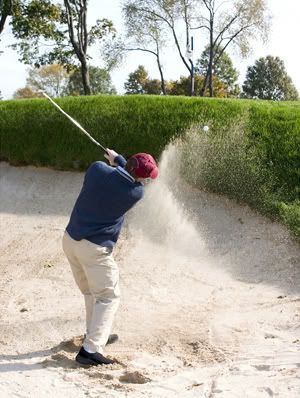
Deep Commitment To Deep Bunker Swing

I don't think I'm getting any shorter, but bunkers seem to be getting deeper. Since I spend about as much time in the sand as a feline with bladder control issues, I needed some help this season.

I dragged Nelson Long with me to the third hole at Century Country Club in Purchase, NY, where he is head professional (although he spends his winters as head pro at Tryall Golf Club in Jamaica, the dog). I pointed into the deepest of the two bottomless pits of despair they call bunkers next to that green and asked him what the heck I was supposed to do if my ball landed in there.

“You’re going to have to use a lot of force to go a short distance,” he replied in his native Virginia drawl. “So you have to sell yourself on swinging hard.” How hard? “It wouldn’t be uncommon for me to swing at this shot pretty much like I’m hitting a full seven or nine iron. Further back, I might go after it as much as I would a driver.”

Just hitting it hard can’t be all there is to it. What else? “Start with the club face open to the sky and keep it open to the sky,” he answered, smiling innocently. He then reminded me to hit the sand behind the ball, not the ball itself. Anything else? “Play the ball off your left heel, and keep your weight more on the front foot. The lower body remains in its starting position, kind of like hitting a bunt in baseball. The backswing is an equal combination of shoulder, arms, and wrist. Then, coming down, you kind of just turn through the shot”

“I rely on at least a three-quarter or full backswing,” he added. “A short backswing will get you into trouble. Sam Snead used to say he was always looking for an opponent with a short, quick backswing and a fat wallet.” Except for the fat wallet, it sounds just like me.

Long then blasted six beauties out of the sand, each one of which landed neatly on the green far above his head. He made this hard shot look easy, so I asked him for one key to remember. “Continue through the shot,” he said.

Dave Donelson, author of Heart of Diamonds a about in the

Saturday, March 21, 2009

A Heavy Concept In Putting

Stephen Boccieri’s aha! moment was 42 years in the making. He started playing golf at the age of eight and spent that long looking for the perfect putter, which he says he found in 2003 and named the Heavy Putter. Not long after his discovery, the now-55-year-old South Salem engineer brought the product to market, selling over 100,000 of them in the last few years.

The Heavy Putter is, well, a heavy putter. It weighs 900 grams (almost two pounds), which makes it about twice as heavy as a conventional putter. The concept, according to Boccierei, is that the extra weight creates consistency, producing a smoother stroke that’s easier to keep on line. I first tried the club at the PGA Show in Orlando last year, and was surprised by how natural it felt.

Boccieri has always been a golf fanatic, but he spent the first 25 years of his professional life as an engineer at Stone & Webster specializing in engineering mechanics. His final position was as a consultant at the Indian Point nuclear power plant, which he says, “was a little nerve-wracking when New York Power Authority owned it.”

In 1994, he started using his engineering skills to analyze golf clubs. Working in his basement (isn’t that where all the great inventors hang out?), he developed a device to measure shaft dynamics, one of the most esoteric facets of golf club design. He figured out that putting weight into the grip of an extra-long shaft like those used by long-drive contestants would make the club more manageable, an idea that would come in handy later.

Of course, Boccieri constantly tinkered with his own clubs. One day in 2003, he added extra weight to his putter head to see what would happen. The result almost snapped his wrist. “It was like swinging a bowling ball on the end of a rope,” he says. Serendipitously, he slipped one of the driver weights he’d been using on long-drive clubs into grip end of the shaft of his putter. “It was delightful. It was like the putter and my arm were one piece.”

The company soon moved out of Boccieri’s basement and set up corporate offices, warehousing, and a custom club shop in Ridgefield, CT. Today, they manufacture most of their product in the Far East, but build about 200 custom clubs in Ridgefield every week. Boccierei did an infomercial in 2006 that was a big success and ran a $750,000 print campaign in the major golf magazines last year.

Acceptance by PGA Tour players is slow to come, Boccieri admits, mainly because their lucrative endorsement contracts prohibit them from using another company’s clubs. That may change, though, as the Heavy Putter scores more wins. Troy Matteson won the PGA Tour's Frys.com Open in 2006 and ran off an impressive string of five Top-10 tournament finishes to rank 36th on the official money list after switching to the Heavy Putter.

Dave Donelson, author of Heart of Diamonds a about in the

Saturday, March 14, 2009

Island Dreams at Sawgrass

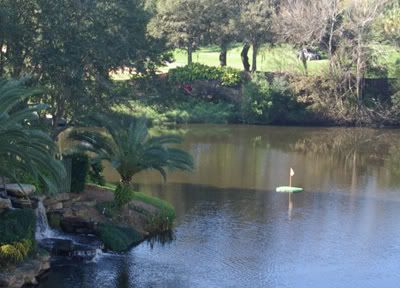
SawgrassYou know you’re at TPC Sawgrass when you look out your hotel room window and see the miniature island green in the lagoon. It’s not the real thing, but it might as well be, since you have just about as much chance of landing your ball there as you do on the real one at the Players Stadium Course, one of five courses at the Sawgrass Marriott Resort totaling 99 holes of fine golf in Ponte Vedre, Florida.

There are 18 holes on the Players Stadium Course, home of the Players Championship since 1982, but the 17th hole generates 99% of the excitement. It’s only 128 yards—the pros play about the same distance but from a slightly different angle—but the tee shot is like trying to land a ball on half of a tennis court. When the swirling winds come up, it’s more like trying to hit a ping pong table at the other end of a football field. Players lose 120,000 balls in the lake surrounding the green every year. Maybe that’s why it’s known as the most frightening hole in golf.

SawgrassThe Marriott Sawgrass Resort provides all the amenities a tired, hungry golfer could want. There are five restaurants on the property, including the Augustine Grille, where you can treat your homesick palate to a serving of Hudson Valley foie gras before tearing into a fine steak. The 25,000 square-foot spa is the place to go after your round for a soak in the whirlpool or the Sawgrass Grand Slam, which includes a hydro and color therapy bath, a deep cleansing and exfoliation, and, for the grand finale, a full body massage.

Sawgrass Marriott Resort & Spa
Ponte Vedre Beach
800-457-4653
www.sawgrassmarriott.com
Nearest airport: Jacksonville (35 minutes)
Golf package: $469 includes room and breakfast, one round on Players Stadium Course for one golfer, forecaddie and other amenities. Note, you must be a guest at the Resort to play the Players Stadium Course.

Dave Donelson, author of Heart of Diamonds a about in the