We've Moved


We've Moved!

Dave Donelson Tee To Green has an exciting new home at
Westchester Magazine.

We're still about all things golf, especially those pertinent to golfers in Westchester and the NY Metro, but now we're in a much bigger space!

Please visit our new home at


Wednesday, July 16, 2014

Add Ballamor to Your Atlantic City Golf Itinerary

Ballamor Golf Club
While no one wants to see clubs go under, one of the silver linings in the cloud over the game has been the conversion of some excellent private clubs to public daily fee operations.  Leading that movement has been the Ottinger family in New Jersey, who took the bankrupt Ballamor Golf Club public in 2010.  The course had opened just nine years earlier.

Today Ballamor offers a wonderful golf experience within a few miles of Atlantic City.  The 7,098-yard course has a strong Pinelands feel, with routing through and around environmentally-sensitive wetlands on a huge 350-acre piece of property without a home in sight.  The architect, Dan Schlegel, then of Ault, Clark & Associates, moved a great deal of earth to create rolling terrain out of what was originally a fairly flat, featureless pine forest.  The result is a manicured and highly playable golf course.

Ballamor opens with a fairly benign 522-yard par five (from the 6,681-yard blue tees) that, like much of the course, features wide fairways and a green to match.  One of the most interesting holes on the course is number 15, a 347-yard par four with a mentally challenging tee shot.  Water is your first test, but then comes the real choice: carry the massive bunker on the left corner of the dog leg with a 220-yard drive or play it safer to the right, leaving a long, bunkers-everywhere-in-site second shot?

The Ottinger family group includes nearby Scotland Run and the tradition-laden Atlantic City Country Club.

Among many other books, Dave Donelson is the author of Weird Golf: 18 tales of fantastic, horrific, scientifically impossible, and morally reprehensible golf

Tuesday, July 15, 2014

Back to Back, Problems That Is

Last week, more than half a dozen Tour pros—including Fred Couples, Jay Haas, and Craig Stadler—had to withdraw from the U.S. Senior Open Championship due to back issues. If you're a normal weekend hacker, you've probably experienced some back issues yourself. There's an orthopedic surgeon that can tell you about mine!

So why do so many of us have bad backs?

Ben Shear

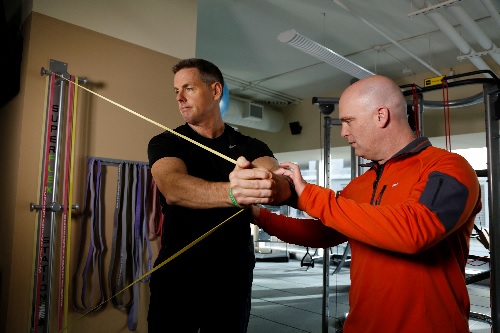
According to Ben Shear, Director of Performance at New York City’s Golf & Body and trainer to a number of PGA Tour stars, for the pros it’s the volume of balls they've hit for so many years. "The speed they generate and the millions of balls they hit, and swinging in only one direction, throughout their lifetime takes a toll," Shear says. "Three or four hours of exercise a week is not going to undo years and years of overuse."

But amateur golfers, says Shear, have a different set of problems, and there’s a lot they can do to limit the damage.  "The biggest problem amateurs have is sitting too much—behind a desk, in the car, in front of a computer. We sit and stand in a rounded position, hunched forward, constantly stretching our muscles along the posterior [rear] side of our bodies and pulling them tight. Therapists call that ‘locked long,’ and it puts constant stretch and pressure on the muscles in our back, shoulders, and hips.

"Now take those stretched muscles, rounded shoulders, and weak hip flexors, and glutes to a golf lesson or to the course, and, without doing any stretches, start swinging. That locked upper back and those weak, tight hips can’t turn, and what’s caught between them? The lower back. It takes the brunt of all that turning and torqueing. That’s enormous pressure on one part of the body and it’s going to give."

Shear’s advice? "I say it all the time.  If you play golf, start by getting a physical assessment from a trainer or therapist who understands golf.  Learn what your body can do and don’t ask it to do something else. Then find a golf pro who will teach you moves that you are capable of making. Don’t go to a pro who only teaches one method if your body can’t make the moves that method demands. That’s a waste of time and money, and could do your body more harm than good."

Combining physical training and golf instruction is the mission of Golf & Body NYC, where the therapists, trainers, and golf pros work together for the golfer’s greatest good both on and off the course. "We assess the golfer’s whole body," explains Shear, "looking for limitations and other concerns. Then we coordinate with the great team of golf instructors here so they don’t try to teach something that the student can’t do. Once the golfer knows more about his or her body, we hope he’ll start an exercise program to work on any deficiencies and fix those weak, stretched muscles. But even if you’re never going to exercise, get assessed."

In the spirit of the British Open, which tees off at Royal Liverpool Golf Club in northwest England this week, Shear offers some advice for golfers making the trip of a lifetime to play in Scotland, Ireland, and elsewhere in Britain where it is often cold and damp. "Warm up before you play," he says. "You need to get the blood flowing and increase your core body temperature. Stretch, do some basic activation exercises, spend a few minutes first on an exercise bike or treadmill. It’s absolutely critical that you get the blood flowing before teeing it up when it’s cool and wet."

Among many other books, Dave Donelson is the author of Weird Golf: 18 tales of fantastic, horrific, scientifically impossible, and morally reprehensible golf

Thursday, July 10, 2014

Steinbreder's 18 Ways to Play Better


If you want to play better golf, your first stop should be at the lesson tee with a PGA professional.  To find out just how good these guys are--as teachers--check out John Steinbreder's 18 Ways to Play a Better 18 Holes.  The veteran golf journalist got eighteen of the best PGA pros to talk about their approach to various aspects of the game and the results are exceptional, no-nonsense nuggets of wisdom just like they would convey to you on the lesson tee.

The list of PGA pros in this book reads like a who's who of America's best golf teachers at America's best country clubs.  It includes Bob Ford from Oakmont and Seminole, Darrell Kestner (Deepdale), Scott Nye (Merion), Eden Foster (Maidstone), and Brian Crowell (GlenArbor).  Topics covered range from sound basics like driving, putting, and bunker play to strategies for competition, fitness, and course management.  Suzy Whaley (TPC River Highlands) even gives a lesson on taking a lesson!

The lessons are based on Steinbreder's interviews with the pros, who were given a chance to read and correct the entries before the final version was published along with a scattering of illustrative photos.  The result is eminently readable and will serve every golfer well.

Among many other books, Dave Donelson is the author of Weird Golf: 18 tales of fantastic, horrific, scientifically impossible, and morally reprehensible golf
Tuesday, July 8, 2014

Happy Tenth To Vineyard Golf at Renault

7th hole Vineyards Golf Par 4

Vineyard Golf at Renault, a delightful course in Egg Harbor City, NJ, celebrates its 10th anniversary this year.  It's great addition to the long list of excellent golf opportunities within a few minutes drive of Atlantic City. With a fine hotel, restaurant, and namesake winery, Renault Winery Resort is actually a worthwhile destination of its own.

The unique 7,200-yard golf course was designed by architect Ed Shearon and features intriguing views of the vineyards as it meanders through the south Jerseys Pinelands.  Every hole seems to offer risk/reward opportunities and thoughtful strategic elements. Wide fairways are inviting but reward the well-placed tee shot, fairway bunkers and water are in play often enough to provide some variety, and the undulating greens place a premium on an accurate approach game.

Five sets of tees give golfers a course to suite every game, ranging from 5,176 to 7,213 yards.  From the recommended white tees, Vineyard Golf measure 6,358 with a 70.2/123 rating/slope.  Any number of holes are standouts, but the seventh is perhaps the most memorable.  From the whites, it plays 400 yards from an elevated tee box surrounded by the vineyard. The right-to-left dog leg is protected by bunkers on both sides of the curve and the approach to the green is guarded by trees left, so club selection off the tee is critical.

The owners of Renault Winery Resort created the golf course ten years ago, but the winery itself dates back to the 1864.  The first vines were brought to America from his native France by Louis Nicolas Renault.  Opened to the public in 1870, the Renault Winery eventually become the largest producer of champagne in the United States at one point; a distinction it was able to claim (and retain) since it was made before the term "champagne" was reserved by French producers.

The winery once had 600 acres of grapes but a large portion of the space was developed into a resort starting in 1983 with the opening of a restaurant. The resort's Tuscany Hotel opened in 2001 and golf was added in 2004. In addition to the small, European-style hotel, Vineyard Golf at Renault features a gourmet restaurant, a historic winery building offering tours, lavish banquet rooms for weddings and celebrations and, of course, a golf course that is as fine as the wine.

Among many other books, Dave Donelson is the author of Weird Golf: 18 tales of fantastic, horrific, scientifically impossible, and morally reprehensible golf

Saturday, July 5, 2014

Brooklyn Open Champs Return to Defend


Both the professional and the amateur champions of the first Brooklyn Open will be back to defend their titles at the Second Annual Brooklyn Open Championship Monday, July 7 at Marine Park Golf Course. Professional champion Pete Meurer of Staten Island and defending amateur champion Neal Fredericksen of Staten Island will be in the full field of 120 golfers that includes 26 professionals and representatives from all five boroughs and surrounding counties. 


"I’m really looking forward to this tournament because it was my first professional tournament victory," said the 57-year-old Meurer, a retired FDNY firefighter and current teaching professional at Staten Island Golf Practice Center. "I have that trophy placed in a nice place to honor in my house. I thought Marine Park did a great job with the changes to the golf course. Before last year I hadn’t played it in 15 years. I went out there the Friday before the tournament and was blown away.”

Last year both Meurer, the 2004 Metropolitan Golf Association Player of the Year, and Gabriel Lee of Bayside carded 1-under 71s before Meurer won the tournament on the fifth playoff hole.  Fredericksen shot a 3-over 75 to capture the amateur title.

Players are scheduled to begin teeing off at 8:30 a.m. on the par-72 Robert Trent Jones designed course. The links-style design will be stretched to 7,091 yards for the professional and top amateur players, making it the longest challenge in New York City.

"The second Brooklyn Open Championship at Marine Park should prove to be a different test than last year’s inaugural tournament in October," said Rich McDonough, Brooklyn Open Tournament Director and Director of Golf Operations at Marine Park. "Summer conditions are more conducive to faster and firmer fairways and greens. The course definitely will provide a different challenge.”

Professionals will be vying for a purse expected to exceed $7,500. Gift certificates will be awarded to the top amateur finishers in each division based on individual flight size. The overall professional and amateur champion will receive a Brooklyn Borough President Trophy. Brooklyn Borough President Eric Adams is scheduled to be on hand to present the Brooklyn Borough President trophies at 3 p.m.

Overall four amateur divisions have been prearranged by handicaps and each will crown a champion. The area’s top amateurs with a handicap index of 8.9 or less are in the first division vying for the amateur’s Brooklyn Borough President Trophy. Amateurs playing in divisions 2-4 will play Marine Park at 6,600-plus yards.

"I’d probably take a 71 again," Meurer said. "As good as that place is they can put those pins in some really tricky spots. With the speed of the greens they can make the course as tough as they want to."

Among many other books, Dave Donelson is the author of Weird Golf: 18 tales of fantastic, horrific, scientifically impossible, and morally reprehensible golf

Thursday, July 3, 2014

Nicklaus Golf Balls Pass My Test

Confused about golf balls?  Do you play a Pro V1 because it's the market leader?  Bridgestone because Freddie Couples is your hero?  Top Flite because they're a dime a dozen or something?  Why not play a ball that's actually going to perform according to your swing speed and fit your game?  Gee, what a concept!

You don't have to make an appointment with a launch monitor to do it, either. Just choose the appropriate ball from the new Jack Nicklaus models based on the tees you usually (or should) play. The Nicklaus White ball is designed for golfers who typically tee off from the forward or white tees; Blue is for those who prefer the middle or blue tees; and Black is for lower-handicap golfers who might use the back or black tees.

Golf Balls
www.nicklaus.com
“By simply knowing the tees golfers play, we can estimate swing speed ranges,” says Nicklaus, winner of more than 120 professional tournaments, including a record 18 majors and 73 PGA TOUR events.  “So, we conceived the balls based on each golfer’s unique ability, be it an everyday player or professional, to score better and enjoy the game even more. All you need to know is the tee you play from.”

The Nicklaus White is for players who swing under 90 mpg (that's most of us, in case you didn't know), Blue for 90-105 mph better players (are you really in the top 10%?), and Black for guys who really do hit their drives 280 yards without a tail wind and three-story down-sloping fairway.

Does it really make a difference?  I put all three models to the test recently in an unscientific but fair trial.  My driver swing speed (91 mph) is right on the line between white and blue. I played each ball for six holes on three different courses--Salem CC, Pelham CC, and Whippoorwill CC--on three successive days.  I played from my usual tees at each, which were:
Salem CC  White tees  6,486 yards  par 72  72.1 rating  137 slope
Pelham CC  Blue tees  6,388 yards  par 70  72.2 rating  138 slope
Whippoorwill CC  White Tees  6,327 yards  par 71  71.4 rating  142 slope 
FYI, I shot my handicap or better on two of the three rounds (Pelham and Whippoorwill) and was over by three shots at Salem so the overall performance was pretty standard for me.

The ball that performed best over the three rounds was the one the literature would suggest for my swing: Nicklaus White.  On the 18 holes I played it, I scored a stroke better than my handicap.  The other two were slightly higher, with Blue at two strokes over and Black one over.  It's not exactly a FDA-human-trial-quality experiment, but it's good enough for me.

Generally speaking, I couldn't feel much difference off the driver face between the White and the Blue but the Black really "clicked" and probably gave me a couple more yards off the tee.  Where the White performed best was with my irons and around the green.  I felt it compress more often with a full swing and it seemed to hold the greens better.  That would make sense given my swing speed.

In addition to easy selection and an easy-on-the-pocketbook price, the Nicklaus Golf Balls carry another big advantage: every sale supports the Nicklaus Children’s Health Care Foundation and St. Jude's.  Available exclusively at www.nicklaus.com and through pro shops at the more than 200 Nicklaus Design courses in the U.S., a percentage of the sales price is donated to the charities.  Consumers using nicklaus.com to purchase balls at essentially a wholesale price also receive free shipping.  If via FedEx delivery services, an additional donation is made to St. Jude.

Online sales save golfers money because distribution costs typically built into product sold through traditional retail channels have been reduced.  This allows Nicklaus Golf Balls to be priced attractively at $28 to $32 per dozen and generate greater charity donations. Visitors to nicklaus.com can also make voluntary contributions; to date, nearly 80 percent of consumers have opted to make a donation.

Among many other books, Dave Donelson is the author of Weird Golf: 18 tales of fantastic, horrific, scientifically impossible, and morally reprehensible golf

Tuesday, July 1, 2014

Marathon Golfer Scores For Eric Trump Foundation

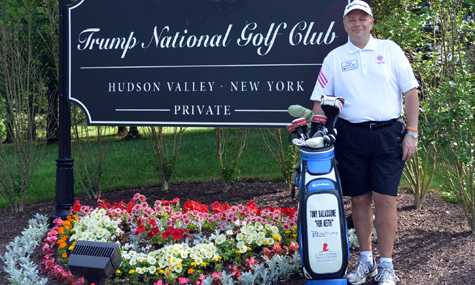
Tony Balassone
What's a big golf day for you?  A leisurely 18 holes? A forced march toward 36? Maybe you've even completed a bone-crunching 54 holes in a state of golf hysteria.  Fuggedaboutit!  You're a piker compared to Tony Balassone, who cranked out a record 451 holes in one day at Trump National Golf Club, Hudson Valley on June 23.  Tony wasn't just feeding his golf habit, though.  He was playing to benefit the Eric Trump Foundation for St. Jude.  His real triumph? He raised $25,000 (and still counting) for the cause.

Balassone, co-owner of Calico Restaurant and Patisserie in Rhinebeck, and his wife, Leslie, raise money each year on behalf of a different charity.  Last year, Tony raised more than $20K for Multiple Sclerosis in memory of his uncle by playing over 90 holes of golf (on foot) at Trump National, walking nearly 26 miles in the process.  Tony was so grateful to the Trump family and Brian Freeswick, General Manager of the club, for donating the course last year that he and Leslie identified The Eric Trump Foundation to be their 2014 beneficiary.

Electing to use a golf cart this year, Tony set his personal goal at 400 (+) golf holes.  At 6:25 AM, Tony teed off at hole number 1 and successfully completed 451 holes in 12 hours, taking 1,909 shots and making 48 birdies.  Don't bother to take your socks off to do the math with your fingers and toes: that's just over 25 18-hole rounds at an average score of 76.

Longtime Hopewell Junction resident, Dan Scavino, an ETF Board Member and Director of the Joe Torre Foundation, was on hand to support Tony Balassone and witness his efforts on behalf of the children.  Scavino also promoted Tony’s incredible feat via social media and with local radio personality “Woodman,” on K104.

A celebratory dinner & auction in honor of Tony Balassone will be held at Trump National Golf Club, Hudson Valley, on July 15, 2014, 6:00PM. Tickets are $125/each and may be purchased via Erin Murray, emurray@trumpnational.com, no later than Friday, July 11, 2014.

Since 2006, Eric Trump, son of Donald J. Trump, and his foundation have donated and pledged over $28 million dollars to St Jude’s Children’s Research Hospital.  If you would like to donate to The Eric Trump Foundation for St. Jude on behalf of Tony Balassone or learn more about ETF’s mission, visit www.erictrumpfoundation.com.


Among many other books, Dave Donelson is the author of Weird Golf: 18 tales of fantastic, horrific, scientifically impossible, and morally reprehensible golf