We've Moved


We've Moved!

Dave Donelson Tee To Green has an exciting new home at
Westchester Magazine.

We're still about all things golf, especially those pertinent to golfers in Westchester and the NY Metro, but now we're in a much bigger space!

Please visit our new home at


Showing posts with label fitness. Show all posts

Tuesday, July 15, 2014

Back to Back, Problems That Is

Last week, more than half a dozen Tour pros—including Fred Couples, Jay Haas, and Craig Stadler—had to withdraw from the U.S. Senior Open Championship due to back issues. If you're a normal weekend hacker, you've probably experienced some back issues yourself. There's an orthopedic surgeon that can tell you about mine!

So why do so many of us have bad backs?
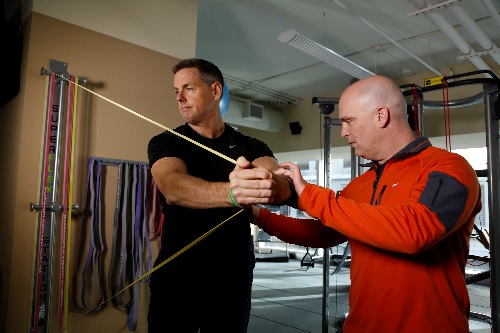
Ben Shear

According to Ben Shear, Director of Performance at New York City’s Golf & Body and trainer to a number of PGA Tour stars, for the pros it’s the volume of balls they've hit for so many years. "The speed they generate and the millions of balls they hit, and swinging in only one direction, throughout their lifetime takes a toll," Shear says. "Three or four hours of exercise a week is not going to undo years and years of overuse."

But amateur golfers, says Shear, have a different set of problems, and there’s a lot they can do to limit the damage.  "The biggest problem amateurs have is sitting too much—behind a desk, in the car, in front of a computer. We sit and stand in a rounded position, hunched forward, constantly stretching our muscles along the posterior [rear] side of our bodies and pulling them tight. Therapists call that ‘locked long,’ and it puts constant stretch and pressure on the muscles in our back, shoulders, and hips.

"Now take those stretched muscles, rounded shoulders, and weak hip flexors, and glutes to a golf lesson or to the course, and, without doing any stretches, start swinging. That locked upper back and those weak, tight hips can’t turn, and what’s caught between them? The lower back. It takes the brunt of all that turning and torqueing. That’s enormous pressure on one part of the body and it’s going to give."

Shear’s advice? "I say it all the time.  If you play golf, start by getting a physical assessment from a trainer or therapist who understands golf.  Learn what your body can do and don’t ask it to do something else. Then find a golf pro who will teach you moves that you are capable of making. Don’t go to a pro who only teaches one method if your body can’t make the moves that method demands. That’s a waste of time and money, and could do your body more harm than good."

Combining physical training and golf instruction is the mission of Golf & Body NYC, where the therapists, trainers, and golf pros work together for the golfer’s greatest good both on and off the course. "We assess the golfer’s whole body," explains Shear, "looking for limitations and other concerns. Then we coordinate with the great team of golf instructors here so they don’t try to teach something that the student can’t do. Once the golfer knows more about his or her body, we hope he’ll start an exercise program to work on any deficiencies and fix those weak, stretched muscles. But even if you’re never going to exercise, get assessed."

In the spirit of the British Open, which tees off at Royal Liverpool Golf Club in northwest England this week, Shear offers some advice for golfers making the trip of a lifetime to play in Scotland, Ireland, and elsewhere in Britain where it is often cold and damp. "Warm up before you play," he says. "You need to get the blood flowing and increase your core body temperature. Stretch, do some basic activation exercises, spend a few minutes first on an exercise bike or treadmill. It’s absolutely critical that you get the blood flowing before teeing it up when it’s cool and wet."

Among many other books, Dave Donelson is the author of Weird Golf: 18 tales of fantastic, horrific, scientifically impossible, and morally reprehensible golf

Sunday, March 30, 2014

Guard Your Back to Protect Your Swing

I learned this stretch (and still use it) after my lower back surgery some years ago.  I was doing the right thing, according to Dr. Jenni Martin, MS DC and LPGA Class A professional.

"Lower back pain is frequently noted as a road block for furthering a golfer's skill and progress in golf.  Often, simple stretches and an understanding of the mechanics and origin of the pain can eliminate this issue," says Martin

Here's how to perform the stretch: Lie on your back. Begin by pulling your knees to your chest and rock slowly back and forth. Now drop your feet to the floor and arms outreached. Slowly drop your knees to the right and then the left. Feel the stretch throughout your lower back while trying to keep your shoulders on the floor.


Using her LPGA teaching background, TPI, orthopedic knowledge, Dr. Martin has created a simple, doable plan that works.  For more information, visit www.thegolfgapper.com.

Among many other books, Dave Donelson is the author of Weird Golf: 18 tales of fantastic, horrific, scientifically impossible, and morally reprehensible golf

Friday, January 31, 2014

Building Power From the Ground Up

Where does the power in your golf swing come from? The ground, of course! That's why a stable base and proper footwork are so important. To improve yours, try the Ground Force Trainer from Golf Gapper, a four-week program that promises to increase your driving distance by 5-15 yards.


The $119 package includes a patent-pending square rotational disk, power pole, DVD, lead leg support foam pad, instruction manual and mesh carry bag. This Ground Force Trainer is used to train golfers in their backswing, where power is developed when the golfer creates ground force with their trailside leg and gluteal muscles. This sensation is difficult to create without an unstable surface during development of this specific action.

"The Ground Force training disks create this instability, causing a specific muscular reaction that exactly mimics the sensation and strength necessary to motor learn the proper load in the back swing and feel the connection with the ground," says Dr. Jenni Martin, MS DC LPGA Class A teacher and club professional who created the product. "The gluteus medius muscle is responsible for hip rotation and hip stability. These muscles also help the golfer maintain balance. The rotational square disks act similarly to a 'lazy Susan' found in the kitchen. They're used in pilates to teach exercises that require movement of the lower and upper body in opposite directions, and to exercise the balance muscles."

The Golf Gapper Ground Force Trainer heightens awareness of strength and muscular awareness, and also enhances balance -- the complete awareness of where your body is in space that movement scientists refer as "proprioception". Square disks are much more effective than round disks here because the square front side gives immediate feedback to the loss of proper muscular and power position of the trail (right side for right-handed golfers) when any movement from front parallel is seen. Seeing any movement from parallel front boards, gives the golfer specific guidance for correction. This creates proper muscular development and motor learning for strength and coil.

Among many other books, Dave Donelson is the author of Weird Golf: 18 tales of fantastic, horrific, scientifically impossible, and morally reprehensible golf

Saturday, January 18, 2014

New Golf Fitness Tool Builds A Modern Swing

Winter will be over sooner than you think, which means it's time to get back to a golf fitness routine that will have you ready for that first tee shot in just a few weeks. ActivMotion Bar is a new workout tool that works on every physical component of your swing from upper and lower body strength to core power and balance.

ActivMotion Bar inventor Derek Mikulski and golf fitness pro Dave Davis have developed this new, easy-to-use tool and workout program using a weighted bar with internal rolling steel weights that force stabilization and engage the core with every move. The ActivMotion Bar helps golfers better maintain their spine angle to stay down on the ball.


Golf fit pro Dave Davis with ActivMotion Bar explains that there are basically two types of swings: classic and modern. The classic swing (think Jack Nicklaus, Gary Player, and Ben Hogan) requires turning the entire lower and upper body together to increase a big shoulder turn to create club head speed. The classic swing requires very little fitness so long as you can turn your entire body to get the club back as far away from the ball as possible. It also requires exquisite timing.

The modern swing, according to Davis, requires the use of the body’s large muscles, dissociating the upper body from the lower to turn the forward shoulder as far as possible from the forward hip. This creates a compact or three-quarter swing. Separating the upper and lower body and loading in the trailing hip creates torque in the core. The modern swing allows you to maintain the club on plane and become more efficient. Players like Martin Kymer, Rory McIlroy, Hunter Mahan, Justin Rose and Tiger Woods use this compact modern swing to create distance and power. And, golf coaches like Sean Foley use this method with players.

This modern swing engages a kinematic sequence, which is force from the ground up that requires the lower body to engage first, then the upper body then the club. This is where the ActivMotion Bar comes into play. Having a strong core to stay down on the ball is essential for a great golf game.

Among many other books, Dave Donelson is the author of Weird Golf: 18 tales of fantastic, horrific, scientifically impossible, and morally reprehensible golf

Tuesday, November 26, 2013

Exercise to Move Shoulders With Stable Hips

Here's a guest post from Dr. Jenni Martin MS DC LPGA Class A teacher and club professional who runs The Golf Gapper in Sacramento.

Learning to engage your core while moving your upper body and NOT moving your hips is essential to a powerful and balanced swing. This is a great exercise after any lower back issues. It is challenging and can be made even more so with the use of a weighted ball.

Sit on a medicine ball. Slowly, arms across your chest, raise each leg and twist with arms across your chest. Do this exercise slowly and to both sides. Switch legs. Do each direction 5 times. Add a weighted ball to increase the difficulty.


Dr. Martin grew up next door to Mark O'Meara and the Mission Viejo Golf Course. Her interest in golfers began years ago while helping Natalie Gulbis.  Her clientele includes students from  + 2 golfers to stroke patients, to those who have never touched a club.

Among many other books, Dave Donelson is the author of Weird Golf: 18 tales of fantastic, horrific, scientifically impossible, and morally reprehensible golf

Saturday, November 16, 2013

Your Winter Golf Plan

Just because winter is coming and the golf clubs are going into the closet for a few months is no reason to stop working on your game. In fact, according to Ben Shear, Director of Performance at Golf & Body NYC, there are many ways to use the cold, indoor months to improve your health and your game so you’ll play that much better when the golf season starts again. 


“Not everyone has to do what Tiger Woods does,” says Shear, “but there are things we all should do if we want to play at a good level.” He adds, “just a few tips or exercises aren't enough to really help you in the off-season. There's much more to gain by using the time to make some important changes not only to how you swing but how you think about your game and take care of your body."

Here are Shear’s five off-season ways to guarantee long-term improvement of your body and your swing.
  • Start a fitness program. “Join a gym, or better yet, join a specialized golf-improvement facility like Golf & Body NYC, where the fitness experts and golf instructors will evaluate your health and golf swing and then work together to create a program tailored specifically for you.” 
  • Get a physical assessment. “If you’re not going to exercise or join a gym, at least get a physical assessment so you know what your body is, and is not, capable of. This is especially good advice if you’re going to work with a golf professional, because he needs to know where you’re flexible, where you’re strong, and where you’re not. Otherwise he might try to teach you a swing you physically can’t make, in which case you’ll never improve—and might even hurt yourself.” 
  • Change your mental outlook. “Average golfers have poor expectations. I don't mean about total score, but shot to shot. They think every shot should be hit perfectly, but no one does. Tour players accept this, recreational golfers don’t. Use the off-season to change your approach, focusing on end results rather than each shot. This is especially good advice when you’re practicing, indoors or out. If you hit a bad shot, don’t change mechanics and swing thoughts, just take another shot. If you’re doing the right things, you’ll be okay. Of course, if you’re missing every shot then maybe you should rethink your mechanics and see a pro. But if you’re working on the right things, you’re still not going to hit every shot perfectly every time.” 
  • Eat and drink better. “First, drink as much water as you can. Second, have a small salad with dinner every night. Third, you don’t have to give up all the bad stuff—the pizza, cookies, cake, candy—but cut that stuff in half and you’ll immediately be healthier. Do that and drink more water and your life will be better.” 
  • Determine your level of commitment. “Understand where you are and what you’re trying to do it. Every one of my Tour player clients has a different level of commitment, time, finances, and energy. But they’ve all thought about how much work they are wiling to put into improving. You won’t have success if you don’t know yourself and how hard you are willing to work.” 
Golf & Body NYC is a private club in Manhattan that enables its members to train like the game’s top players. In fact, Shear works with a number of PGA Tour golfers—including Luke Donald, Webb Simpson, Jason Day, and Bo Van Pelt. His total-body programs are proven to improve health and golf performance for the best players in the world, top amateurs and weekend golfers at all levels.

Every membership includes a full physical evaluation by Shear’s staff and a golf swing evaluation by the professional staff. For more information, contact Jeannine Harrington, General Manager at (212) 244-2626 or go to www.golfbodynyc.com.

Among many other books, Dave Donelson is the author of Weird Golf: 18 tales of fantastic, horrific, scientifically impossible, and morally reprehensible golf

Sunday, November 10, 2013

Stretch For Golf Swing Width

An effective golf swing requires the ability to reach out and roll your shoulders, according to Jenni Martin, LPGA member and TPI-certified medical and golf professional.  Martin points out that sitting at a desk like I do all day impedes that ability. Here's a stretch she recommends for regaining flexibility in your shoulders and lats.

While on your knees, reach out over a medicine ball. Feel the stretch in the front, sides and back of your upper arms and back. Hold this stretch for 5 seconds and then slowly roll to the left, holding for another 5 seconds. Now roll to the right side, maintaining the feeling of a full stretch. Repeat this series 4 times. Do this great stretch daily for additional width in your swing.


"The lack of shoulder flexibility can cause lose of distance off the tee," Martin says. "Flexible shoulders and back create swing 'width' and width equals speed and more distance."

Martin works in Sacramento, where she uses here LPGA teaching background, TPI training, and orthopedic knowledge (she's a DC as well) to help players of all levels improve their games physically and mentally.

Among many other books, Dave Donelson is the author of Weird Golf: 18 tales of fantastic, horrific, scientifically impossible, and morally reprehensible golf

Wednesday, July 10, 2013

Beer and Golf: The Swing Oil Myth Exposed!

Beer and Golf
It’s one of the great burning questions in golf: does alcohol make you play better or just think you play better? In other words, should you drink while playing? According to Dr. Phil Striano, “It all boils down to whether you want to shoot the lowest possible score or to have the best possible time.” Guess which choice involves loading a cooler into your golf cart?

Putting the whoop-it-up factor to one side for a minute, we decided to find out just how alcohol affects your golf swing. We turned to Striano, a Titleist Performance Institute certified chiropractor and avid, low-handicap golfer, to apply some science to the question in his golf studio at Rivertowns Chiropractic in Dobbs Ferry. Under (barely) controlled conditions, we asked a dozen pretty average golfers to hit some golf balls into a net, drink a few beers, hit some more balls, drink some more beer, hit more balls, drink, hit, drink, hit, etc. The test grew a little raucous, but the goals of science were eventually served.

Striano and Keith Melnik, assistant pro at Ardsley Country Club, used some of the latest technology, the K-Vest, which plots the movement of the body during the golf swing, and the TrackMan radar system, which measures swing speed, shot distance, accuracy, and a bunch of other metrics, to analyze the groups’ performance. We used a conversion chart to estimate blood alcohol levels based on their body weight, consumption, and time spent drinking.

The guinea pigs were golfers just like you and me. They ranged in age from 25 to 64, handicaps from 0 to 25, and number of rounds played per year from 10 to 50. Every one of them said they drank while playing—at least sometimes—and most said they felt more relaxed when they did. Most of them figured a little “swing oil” improved their game although more than one confessed they really didn’t know. Or care.

Our volunteers didn’t shirk their responsibilities. They consumed anywhere from three to eight beers (yes, we were counting!) and hit 229 balls (not including warm-ups and goofing around) for the test. By the time they finished, five of them were over the DUI limit of 0.08% blood alcohol and most of the rest were really, really close to it.

The results? Not surprisingly, the more beer you drink, the worse you play. Quite frankly, though, especially considering how many of the volunteers were slurring their words and telling raunchy, pointless jokes by the end of the test, the impact on their swings wasn’t too bad. The distance they hit the ball suffered the most, with the average loss of 8.2 yards in carry using a six iron, although three of the twelve gave up more than 20 yards.

Accuracy actually improved a bit for the group after they’d had a few, at least as measured by how far the ball landed from an imaginary target. The average was about two yards closer, although five of the players got worse while seven became just slightly better—or luckier. When you combine distance and accuracy, average player performance went down by about 4% when alcohol was involved.

There was a clear correlation between blood alcohol levels and golf ability. As more pickling agent hit the blood stream, the golf swing became more erratic. Incidentally, high handicappers suffered proportionately more, as did older golfers.

Striano and Melnick analyzed the K-Vest data to see just how the golf swing responds to a suds bath. “When you start drinking, a whole lot of things happen. Beginning with alignment, the golfer becomes erratic,” Striano said. “Plus, there’s no question that there is a definite swing oil effect. Most of the guys got a lot looser and there was more turn in their hips and shoulders.”  Yes, but did it help?  “That made their swings longer, which actually reduced how far they hit the ball.”

We couldn’t measure the effects of beer on the golfer’s judgment, although given the way many of them were acting after a few, we suspect it doesn’t get more conservative. Carry that water hazard with this three wood off a down-hill lie? Sure—why not!  Equally un-measureable was the attitude factor, although our test subjects were certainly happier at the end of the test than when they began, regardless of how—or where—they hit the ball.

Perhaps the best guidance about booze on the golf course came from a real aficionado of both, Dean Martin, who once said “If you drink, don't drive. Don't even putt.”

Among many other books, Dave Donelson is the author of Weird Golf: 18 tales of fantastic, horrific, scientifically impossible, and morally reprehensible golf

Wednesday, April 3, 2013

Five Iron Fitness Presents New Golf Video Series

Here's the first of what promises to be a great series of playing tips from some of the many fine teachers in the Met Section. The videos are produced by a real master of golf fitness, Anthony Renna of Five Iron Fitness in White Plains.

In Episode 1 of Golf Tips from Around The Met, Paul Kenney from Rockrimmon CC in Stamford, CT, joins Renna of Five Iron Fitness to show a few drills to help understand how you should be at address position. Filmed at BioSport Technologies, in Greenwich, CT.


Among many other books, Dave Donelson is the author of Weird Golf: 18 tales of fantastic, horrific, scientifically impossible, and morally reprehensible golf

Wednesday, June 20, 2012

Build Your Swing From The Ground Up

A good golf swing requires flexibility and range of motion, but unless your body has the stability to control all of that movement, your swing will be erratic. And stability starts from the ground up, according to Five Iron Fitness trainer Anthony Renna whose White Plains, NY, studio is devoted solely to golf—and regularly attracts outstanding local pros like Craig Thomas, Mike Diffley, and CJ Reeves, not to mention LPGA Futures Tour pro Nanette Hill.

As with all exercise, warm up first with a few minutes of aerobic activity and don’t force your body to do anything that causes pain. Start slow and build up your performance gradually. Renna suggests holding each position through one deep breath, then repeat three to five times in both directions.

Side Rotation

Lie on your side and draw up the knee of your top leg until it’s even with your belly button. Holding it steady with your lower hand, reach as far up and back as you can with your other arm. Keep your lower back stable, but try to touch your shoulder blade to the ground by turning your around your upper spine.

Plank

This position is familiar to every yoga practitioner. Brace your elbows directly beneath your shoulders and hold your neck in a neutral position as you raise your body off the ground. Make a straight line from your ears, through your hips, and to your ankles. You’ll build core strength and teach your spine to be stable.

Quad Rotation

Start on your hands and knees, then place one hand on the back of your head and turn until the elbow on that arm is between your other elbow and knee. Holding your lower back stable, rotate until the elbow points to the sky.

Hip Stretch

Notice how each exercise is raising your body farther from the floor? Kneel on one knee with the other foot flat on the floor in front like you were going to stand up. Holding a club with both hands in front of you, rotate in both directions as far as you can without moving your knee or hips. Be sure to move your chest, too, not just your arms. This is a good exercise to fight a pesky sway in your golf swing.

Seated Rotation

You can do this on a chair if you don’t have an exercise ball. Sit with your knees and feet together and hold a club across your chest with crossed arms. Now tilt forward slightly and rotate your shoulders just like you would in a golf swing. Notice how the club tilts, too? That’s the path it would follow to the ball—as long as your lower body stays stable.

Hip Hinge

Standing in an athletic position with your knees slightly bent and your weight on the balls of your feet, hold a club along your back so that there are just three points of contact—your head, your shoulders, and your butt. Now lean forward as if you were addressing a golf ball. This move helps you eliminate rounded shoulders or a swayed back and helps you maintain a strong, neutral spine. You can’t rotate your swing around a noodle.

Torso Separation

This is the golf swing in miniature done on a stable base and rotating around a stable spine. Assume an athletic address position, only hold the club across your chest and shoulders with crossed arms. Leaning forward slightly as if you were going to take a swing, rotate your shoulders as far as you can in both directions without moving your hips or lower body.

See these exercises (and more) in video at www.fiveironfitness.com/wmgg

Among many other books, Dave Donelson is the author of Weird Golf: 18 tales of fantastic, horrific, scientifically impossible, and morally reprehensible golf

Wednesday, April 6, 2011

How To Avoid Golfer's Elbow This Season

A guest post from Dr. Michael Hausman, Orthopedic Surgeon and Specialist on Hands and Upper Extremities and Chairman of Orthopedics at Mount Sinai.

Each golf season, numerous golfers unknowingly continue habits which result in golfer’s elbow. Golfer’s elbow, also known as medical epicondylitis, is similar to tennis elbow, but occurs on the inside, as opposed to the outside of the elbow. It is usually a pain or discomfort that forms where the tendons of one’s forearm muscles attach to the bone on the inside of the elbow. The pain may spread into one’s forearm and wrist. Most common at the beginning of the golf season, this injury is typically due to the repetitive activity and increased duration.

The pain of golfer’s elbow doesn’t have to keep you out of the game or hinder the start of the season – if you keep in mind a few easy tips:
1. Golf Clubs - It is crucial to make sure that you are using golf clubs that are sized properly, including grip size.
2. Stretching & Exercises - Some simple stretches and exercises reduce the symptoms of golfer's elbow. These exercises should not cause pain. By strengthening the muscles and tendons involved with golfers' elbow, you can help prevent the problem from returning.
3. Anti – Inflammatory Medication - If you do feel persistent pain in the elbow area, using an anti – inflammatory medication is suggested to control the pain and inflammation.
4. Alternatives - A cortisone injection is another option if other methods have not helped to subside the pain; however, if a patient has tried more than two cortisone injections and has not felt relief, it is unlikely such injections will benefit the patient.
Dr. Michael Hausman has appeared on national and local TV and radio, as well as in many print outlets as a resource on orthopaedic care and injuries specifically on the hands and upper extremities. Dr. Hausman is currently the Robert K. Lippmann Professor of Orthopedic Surgery and Vice-Chairman of the Department of Orthopedics at Mount Sinai. He is an internationally recognized upper extremity surgeon who treats disorders of the hand, elbow, shoulder and peripheral nerves.

In addition to writing about golf, Dave Donelson distills the experiences of hundreds of entrepreneurs into practical advice for small business owners and managers in the Dynamic Manager's Guides, a series of how-to books about marketing and advertising, sales techniques, hiring, firing, and motivating personnel, financial management, and business strategy.