We've Moved


We've Moved!

Dave Donelson Tee To Green has an exciting new home at
Westchester Magazine.

We're still about all things golf, especially those pertinent to golfers in Westchester and the NY Metro, but now we're in a much bigger space!

Please visit our new home at


Wednesday, June 17, 2009

US Open Holes To Watch

As I wrote earlier, this year's US Open at Bethpage Black will be a substantially easier scoring event for the pros than the 2002 tournament. Here are a few holes where you're going to see lower numbers, especially from big hitters:

Number 6 - 408 Yards Par 4 - The hole is short under normal conditions, but will play much shorter this year. As traditionally laid out, you had to play a conservative shot to a tiny landing area on top of the hill between two fairway bunkers, leaving a short iron to the green that's 50 feet below the driving area. Hit anything longer off the tee and you were in the rough that covered the hillside to prevent balls rolling down to the bottom fairway. The USGA did away with that rough for the Open this year, which will allow a tee shot over the left fairway bunker to catch that slope and roll down to within flip-wedge distance to the green. It won't have to be a driver, either, since the carry is only about 270 yards from the back of the back tee. I can envision some bigger hitters going with a driver, though, and making the greenside bunkers, which aren't particularly punitive by Bethpage standards.

Number 7 - 525 Yards Par 4 - The USGA is touting this as the longest par 4 in US Open history and, at 525 yards, it sure looks like it on the scorecard. Again, though, the hole won't play that long especially since the tees may be moved up to encourage more risk-taking. Even from the back, a 300-yard drive will clear the dog leg and leave less than 200 yards to the green. The USGA has actually widened the fairway to encourage players to challenge the oak trees that guard the right side. Count on that happening a lot. Even a player that doesn't cut the dog leg will be left with a mid- to short-iron.

Tiger Woods at Bethpage, courtesy of USGA/John Mummert
Number 9 - 460 Yards Par 4 - This was the easiest hole in 2002 and, despite a new tee some 40 yards back and a new bunker off the fairway to the left, I still don't think it will pose problems for the big boomers. They'll be able to carry that bunker, possibly with something less than a driver, and leave themselves a wedge to one of the easiest greens on the course.

Number 13 - 605 Yards Par 5 - The new tee and new deep bunkers left of the driving zone will make this a harder hole for everyone but those guys who hit 320 yard drives with regularity--which includes an awful lot of players in the US Open field. The green will be reachable in two by those guys, with the vaunted cross bunkers not a factor for them (or really for anyone else). There is a bunker that appears to guard the approach to the green that should make someone think twice about trying to reach on the second shot, but it's actually 30 yards in front of the putting surface, so running the ball onto the green will happen fairly often. Even the player who lays up for some reason will have an easy third shot that should set up plenty of birdies. There is no real punishment for taking a chance here, so players who shoot par will have definitely lost a shot to the field.

For a really good overview of the entire course--with expert commentary by my friend Brian Crowell--check out the NBC flyover videos. Brian and I may be friends, but we definitely have a few differences of opinion!

Dave Donelson, author of Heart of Diamonds a about in the

Tuesday, June 16, 2009

Succeeding At Ping - Part 4 of 4

This series looks at what's next for Ping Golf as the company celebrates it's fiftieth anniversary this year.

John K. Solheim is often considered the heir apparent at Ping. Yet, he says,
"Talking to my dad, I don't get a lot of that. He hasn't anointed me. Both of my father's brothers retired at 65, but I'm not sure what the plan is for him." Andy says he'd like the CEO job, too. "I don't know what my dad's plans are," Andy says. "I look at the third generation, and most of us are pretty young."
Leslie Dashew, a family business advisor in Scottsdale, says it makes sense for a business leader to take a cautious approach to succession decisions.
"When families are [carefully] thinking through this process, it provides a great deal of security to employees," she says. "If you want to run the business well, you run it like a business. You find the best talent. That may or may not be a family member."
Doug Hawken, 58, Ping's non-family president and COO, says he's not privy to the succession planning but feels good about the prospects.
"We have a good balance of family members and non-family members at leadership levels," he says. Hawken might be considered a prospect to succeed John, but the two men aren't that far apart in age. Hawken says he only wants one thing: "Whoever takes on that leadership role at this company has to have the same passion as Karsten had and John has. You don't just assign somebody that passion -- they either have it or they don't."
John turned the company around, streamlined it and worked through many of the rough spots, but there is still plenty of work to be done. Golf in the U.S. isn't a growing sport, but the international market is just waiting to be tapped.
As John K. points out, "In Japan, we don't even have 1% of the marketplace. And that's the second largest golf market in the world!"
In recent years, Ping opened new assembly facilities in both Japan and Europe as part of its strategy to take its rapid delivery system to the international market.

There is also some low-hanging fruit domestically, according to John K.
"We've been a little slow to adjust to the market's move from green-grass [golf course pro shop] outlets to retail stores," he says. "They've really taken over the hard goods side of the business. We have great relationships with the golf course owners and operators, but, at the end of the day, the consumer isn't buying product there."
Doug Hawken watched the generational transition from the vantage point of a non-family insider and offers a positive outlook for the future:
"Since John has taken control, we've returned to a good position within the marketplace," he says. "We've had four years of growth now, but he's willing to listen to the fact that we need to get our group together to go forward."
This article appeared in Family Business Magazine, Summer 2008

Dave Donelson, author of Heart of Diamonds a about in the

Monday, June 15, 2009

Lost At The Open

The famous "difficult course" sign on the first tee at the Black might also apply to the freeways on Long Island. I went bright and early to Bethpage this morning to pick up my media credentials, managing to beat most of the crowd and avoiding the lines, probably for the last time this week.

It was fun watching a little of today's practice rounds. I also hung around the practice tee for awhile, then went over to the practice green, where at least half the spectators on the course were gathered to watch Tiger. He wasn't practicing, you understand, just standing there chatting with Steve Williams and Hank Haney and a couple of guys I didn't recognize. As far as the crowd was concerned, though, he was putting on a show. You could see them just drooling for him to walk along the fence and shake a hand or two, which was the furthest thing from his mind, of course.

I had to get home, however, so I walked back to catch the shuttle to the media parking lot where I'd left my car. Considering how far away it was from the course, I might as well have parked at home. When I asked one of the helpful USGA volunteers where to catch the shuttle, they directed me to a trailer. When I told the even-more helpful volunteer inside where I wanted to go, she hopped right to the task, called a driver over, and handed him the keys to a courtesy car!

The volunteer driver, an older man from Farmingdale, drove over an orange traffic cone in his eagerness to be of service, told me he knew exactly where I had parked, and we were off.

As we left Bethpage State Park, nothing looked familiar to me, but the driver assured me he knew where he was going, so I sat back to enjoy the ride. Thirty chat-filled and wrong-way minutes later, we pulled into the wrong hotel parking lot. Finally, I convinced him to follow the directions I'd been trying to give him all along. Eventually we got there.

Next time, I'll wait for the shuttle.

Dave Donelson, author of Heart of Diamonds a about in the

Sunday, June 14, 2009

GlenArbor Teaches Life Lessons

Not all the good things that happen on a golf course involve little white balls. The fine folks at GlenArbor in Bedford, NY, have found a way to make great use of their facility for another fun--and very worthwhile--endeavor: environmental education.

GlenArbor Environmental Education
A group of kids from West Patent Elementary School recently visited the course for a hay ride tour with Superintendent Ken Benoit that included stops at a bluebird nest box where they discussed nesting and predators and at a stand of rare Dawn Redwoods where the talk was about the importance of trees to the air we breathe as well as the aesthetics of the golf course. They made a visit to the 17th green to talk about grass as an oxygen-producer and the many substances that make up healthy soil, and finished at a lake on the course where they observed fish, two types of turtles, and ducks, swans, and a Great Blue Heron.

Near the 15th tee they stopped to see the wetlands where the swans nest, then it was off to the 14th tee to see the nearby wild flowers and their pollinators, the bees, butterflies, and humming birds. Along the way, they looked for other wildlife that inhabits the course and surrounding countryside including fox, coyote, deer, turkeys, hawks, rabbits, raccoons, and skunks. The day included a honey bee hive demonstration, slide show, and even a box lunch served near the short game practice facility.

The kids had a great time and learned a bunch about the world we live in.

Next time I'm searching for a ball in the tall grass or cursing that big tree between me and the green, I hope I can step back and enjoy the place I'm playing the same way these kids did.

Dave Donelson, author of Heart of Diamonds a about in the

Friday, June 12, 2009

Ridgeway For Sale?

Ridgeway CC #8
Officially, Ridgeway Country Club in White Plains, NY, is on the market. A recently-published article says the asking price is $20 million for the 130-acre tract which is zoned for single-family homes on three-quarter-acre lots. When I was there recently for a MGWA event, though, club president Henry Shyer said a sale will be a last resort. He's hoping to attract members to replace the 50 or so who resigned this year by offering sharply reduced membership fees and a monthly payment plan.

Head pro Pete Donnelly, a White Plains native and congenial chief of the Ridgeway pro shop for 29 years, said changing lifestyles are making club memberships less attractive to younger people, which only compounds the difficulty of replacing the members who left because of the sharp downturn in the economy. The club membership has been declining for several years.

Donnelly added that the club now regrets its deal-killing hesitation to accept an offer from local real estate developer Louis Cappelli to buy 150 memberships for use by guests of his nearby Ritz-Carlton Hotel, which opened last year. Given the economic climate, that offer is most certainly off the table now.

It would be a shame to lose this venerable member of Westchester's golf community. The course was built in 1923 and has gone through several iterations resulting in today's version with narrow fairways, tiny, slick greens, and some interesting bunker complexes. The club also has 10 tennis courts, an Olympic-size pool, and a fitness room. It's also known for fine dining. Having sampled the fare, I can attest that the food is as good as the golf.

Dave Donelson, author of Heart of Diamonds a about in the

Sunday, June 7, 2009

Succeeding At Ping - Part 3 of 4

This series looks at what's next for Ping Golf as the company celebrates it's fiftieth anniversary this year.

When John Solheim took over the management of Ping in 1995, the change supercharged the company. He expanded the product line into metal woods, set up a rapid-delivery system to hold on to the company's position in the custom-fitting market and hired Ping's first advertising agency. He also divested several other operations that weren't directly related to the company's roots as a club maker.

Not long after, his own sons moved into management positions in the company.
"At our age, the third generation has a lot more influence than the second generation did at the same age," David Solheim observes. "That's a credit to the second generation for allowing us to get our hands dirty."
Andy Solheim, 31, is director of customer relations. Domestic and international customer service, credit and club fitting and repair all fall under his aegis. Like his brothers (and his father, for that matter), he's never worked anywhere else. He says he learned what it means to be a Solheim early in his career.
"One time, I had just finished my master's degree and had helped do a video for a national sales meeting," Andy recalls. "I was just going to show up, watch the video then go back to the office, so I was wearing shorts and a casual shirt. My father gave me 'the look.' Fifteen minutes later, I had a suit on."
John's oldest son, known as John K., is 33 years old and the one who inherited his grandfather's engineering talent. He holds an MBA as well as a degree in mechanical engineering. As vice president of engineering, he says, he has tried to expand the design function beyond the one-man-one-idea operation it was under Karsten. He's hired several design engineers with backgrounds in the sport and has concentrated on speeding the time to market for new products. One of the company's biggest changes came with the purchase -- at John K.'s urging -- of a supercomputer, which shortened the wait time for design analysis from 15 hours to 15 minutes.
"The Cray Supercomputer was one of those times when my dad and I were on the same page," John K. says. There were plenty of other times when they weren't, including several disagreements over product design. In fact, their relationship bears some resemblance to the one between Karsten and John, according to John K.: "We may have to name another road 'John's Way.' He has his own way of doing things."
That may not bode well for the looming management transition from the second generation to the third, although John says he's working to ensure a smooth handover of operations.
"My dad was well into his 80s when he finally turned it over, and I don't intend for that to happen," John says. "I'm not in any hurry to leave, but, at the same time, we have to have the best person for the job. The family members have to compete with everybody else."
The family is working with consultants to help them address succession issues.

Dave Donelson, author of Heart of Diamonds a about in the

Friday, June 5, 2009

Rye Golf Club Leaps Forward

One of the best surprises I've had in a long time came when I played the Rye Golf Club for the first time in about five years. Since I was there last, the venerable municipal course has undergone some major revisions and taken giant leaps forward in conditioning. Now, I'd rank it among the best publicly-owned courses I've seen.

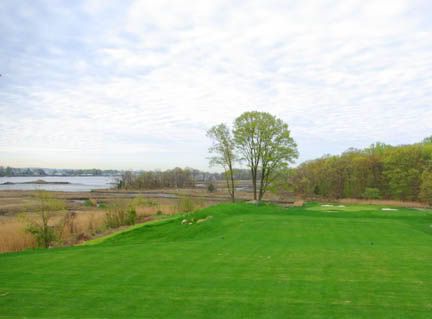
One of the unique features, as head pro Mike Rapisarda never tires of telling people, is that it is the only course in Westchester where you can hit a ball into Long Island Sound. In fact, there are two holes where that dubious feat can be accomplished. One is the 315-yard par four twelfth hole that just begs for a big hitter to drive the green, thereby bringing the sound into play on the left. The other is the tortuous par three seventeenth, seen below at low tide. The green is about the size of a dinner napkin and the wind can easily take your ball out to sea if you're not careful.

Rye Golf Club #17
The par 71 track was originally laid out by Devereux Emmet in 1921, but I don't imagine the old boy would recognize it today. The course has been stretched to 6500 yards, every tee and bunker has been rebuilt, the fairways converted to bent grass, and hundreds of trees have been taken down to open more of the course to those wonderful Sound views. All of the work, by the way, has been designed and carried out by Superintendent Chip Lafferty, who came to the course in 2003.

The course is owned by the City of Rye, NY, and is open to members and their guests. I recommend you find a member and beg an invitation.

Dave Donelson, author of Heart of Diamonds a about in the