We've Moved


We've Moved!

Dave Donelson Tee To Green has an exciting new home at
Westchester Magazine.

We're still about all things golf, especially those pertinent to golfers in Westchester and the NY Metro, but now we're in a much bigger space!

Please visit our new home at


Showing posts with label Tillinghast. Show all posts

Saturday, November 2, 2013

Spring Lake Starts Renovation

Golf course architecture firm Tripp Davis and Associates has started work to carry out its two-year Master Plan for renovating and restoring Spring Lake Golf Club’s historic course.  Located on New Jersey’s north shore, the club’s original 18 holes were designed by George Thomas (the genius behind Riviera Country Club) in 1911.  In 1918, A.W. Tillinghast, one of America’s greatest golf course architects, was engaged to redesign, strengthen and update the course.

Golf architect Tripp Davis, who is noted for his work with historic golf courses around the country, was asked by Spring Lake Golf Club in 2011 to create a strategic plan that would restore the character of the course first laid out by Thomas and later improved upon by Tillinghast.  “Our direction and focus in developing a Master Plan for Spring Lake was to keep Thomas’s solid routing intact, then look to what Tillinghast did so we could work to reestablish the importance of angles off the tees, restore and enhance the strategic intent of the bunkers and return them to their original style,” said Davis.  “Additionally, fairway widths that were altered over the years will be regained, the once sandy scrub areas that were a prominent feature will be reintroduced, some greens will be rebuilt, and overall there will be a more open feel to the landscape.”

With Spring Lake being so close to the Atlantic, Davis and his team will introduce Fine Fescues in various areas to promote more of a seaside feel.  While making the course more strategically interesting for modern play, the end result is to let golfers experience a step back in time.

“I am very excited to start our work at Spring Lake,” Davis commented.  “It is a special place that will have a stronger connection to its heritage when we are done.”

The Master Plan is being implemented in phases with the first phase beginning October 15th
on the back nine bunkers, sandy scrub areas, select tees, the expansion of certain greens and  fairways, planting of Fine Fescue areas, as well as some drainage improvements.  The front nine changes are scheduled for October 2014.  Tripp Davis and Associates most recently completed a renovation and restoration of the Tillinghast designed Brook Hollow Golf Club in Dallas, Texas.

Among many other books, Dave Donelson is the author of Weird Golf: 18 tales of fantastic, horrific, scientifically impossible, and morally reprehensible golf

Monday, September 9, 2013

Southward Ho Discovers Two Tillinghast Features

Golf architect Ian Scott-Taylor and Tillinghast authority and biographer Philip Young have made a discovery of significant historical importance at Southward Ho Country Club in Bay Shore, New York.  They found both a "Reef Hole" and a "Hell’s Half Acre" hazard are very much in evidence at this 1923 Tillinghast gem, which notably is his only true seaside links project.  The two features have never before been seen on the same Tillinghast design.

"Long Island’s Southward Ho presents two unique golf holes that no other Tillinghast course has today," stated Scott-Taylor.  "This is an astonishing discovery and the club was unaware of its good fortune in having preserved the original design of Tilly’s remarkable par-3 ‘Reef Hole’ while possessing vestiges of the devilish ‘Hell’s Half Acre’ great hazard."

A.W. Tillinghast is one of the game’s most prolific Golden Age designers with work on some 265 courses to his credit.  He designed such venerable courses as Winged Foot, Newport Country Club, Quaker Ridge, Baltusrol, San Francisco Golf Club, Bethpage and many others.

Tillinghast's Reef Hole
According to Tillinghast expert Young, the genius of the "Reef Hole" design allowed golfers of various skill levels the chance to score par by approaching the green from four different routes with only one of them being a direct single shot to the guarded green.  "In this single hole concept, the brilliance of Tillinghast’s ability to design a hole to be playable for the average or lesser player, while also challenging the talented one, stands out for all to see," explains Young. "Southward Ho’s 14th long par-3 ‘Reef Hole’ is a fine example of Tilly’s template and every significant required feature of this innovative hole design can be clearly seen here."

The discovery also of a Tillinghast "great hazard" at Southward Ho is equally important to students of classic golf course architecture.  He coined the phrase to define a specific style of large hazard and he also invented one of the great examples of a "great hazard" which Tillinghast called the "Hell’s Half Acre Hazard."  The name originated from a notoriously dangerous and unsavory area of Philadelphia, the city’s Hell’s Half Acre, the last place any decent person would want to find themselves.

A true "Hell’s Half Acre Hazard" incorporates a combination of numerous mounds, rough of all sizes and types, sand both in regular bunkers and/or waste areas, scrub grasses and/or bushes, especially on the outer portions, and it would range in size from 20 to 60 yards in length and always cross the entire fairway from one side of the rough to the other.

"When Ian excitedly informed me that he discovered Southward Ho had a ‘Reef Hole’ and we subsequently visited the course with club members and officials, I was astonished to identify and verify that they also were in possession of a ‘Hell’s Half Acre Hazard,’"exclaimed Young.  "That Southward Ho has these two incredible original Tillinghast signature design features on its course makes both the course and the club unique and most special.  It’s a discovery of great magnitu hs course makes both hthe course and the club way from one side of the rough to the other.would rde and exciting for all admirers of Tillinghast’s work."
 
Among many other books, Dave Donelson is the author of Weird Golf: 18 tales of fantastic, horrific, scientifically impossible, and morally reprehensible golf

Thursday, June 13, 2013

Fenway Puts the "Class" in Classic

Fenway Golf Club
Third hole at Fenway Golf Club. Photo courtesy of the club.
Among all the doom and gloom about the supposedly inevitable decline of the sport of golf, it's always heartening to see a club that belies the tales of woe. Fenway Golf Club in Scarsdale, NY, one of the shining stars on the Westchester golf stage, is thriving. The reason? The Fenway membership didn't retreat into a bomb shelter during the tough times with their hands clamped on their wallets, but instead invested in the course, made adjustments to policies to fit modern lifestyles, and made a major commitment to improving the golf experience for new and existing members.

Gil Hanse was hired a couple of years ago to revisit the classic Tillinghast design and the completion of his work this spring really shows on the course. Numerous bunker complexes were expanded, a couple were added, and all of them were completely rebuilt to meet modern drainage and maintenance standards. In addition, some air-choking trees were selectively removed to improve circulation on a few greens with the additional benefit of opening some excellent vistas across several fairways.  Superstorm Sandy took care of a number of other monster trees that had out-grown their usefulness, resulting in improved play-ability on several holes.

Fenway is one of the most strategically complete golf courses in the area. At 6,714 yards, par 70, it truly tests every facet of your game. Eight of the par fours are over 400 yards (the #1 handicap fifth hole plays 480--uphill!), but there are some devilish short holes as well. The fairways are generous but extremely well-bunkered (see the picture of the third hole above). Greens vary in size according to the length of the approach shot, but all are strongly contoured and typically very slick. When I play Fenway, I literally use every club in my bag at least once.

Brand new this year is a fine new short game practice area designed by Hanse to help members hone specific shots that pester them on the course. Included in the complex is a huge kidney-shaped green complete with a false front on one lobe that would warm the cockles of Tilly's heart. There's also a nasty, narrow greenside bunker similar to the ones around the seventh green, an extra deep one just like the ones to the right of the ninth green, and a creatively designed bunker with a long tongue that allows practice of long bunker shots in one direction or holds up to six players at a time facing sideways for group lessons. Pitch and chip shots as long as 65 yards can be practiced from all sorts of lies in fairway or rough.

Membership has grown accordingly, including an influx of younger members with kids, which bodes well for the future of the game at Fenway. So does the attitude of the club's membership, which is dedicated to growing the game the right way: by providing an excellent golf experience.

Among many other books, Dave Donelson is the author of Weird Golf: 18 tales of fantastic, horrific, scientifically impossible, and morally reprehensible golf

Wednesday, September 12, 2012

Inside The Mind Of Golf Architect Jim Urbina

Paramount Country Club 18th Hole - photo by Larry Lambrecht
The restoration of Paramount Country Club's classic Tillinghast golf course enters its final phase this fall under the direction of Jim Urbina, named along with Tom Doak in 2010 as "Architect of the Year" by Golf Magazine. I wrote about the project earlier and Urbina reported on his progress at Paramount at a recent Metropolitan Golf Writers event.

When he first saw the course, Urbina said, he was struck by the views. "I went up to the highest points, over by the first green and second tee and over by the sixth green. It's somewhat masked by the growth of trees but you can tell it has a sense of scale." Many of the trees have been selectively thinned out during the renovation, restoring the vistas of High Tor and the Hudson Valley. Urbina's work has also revealed the scale of the property, giving the player a better feel for Tillinghast's concepts.

"Tillinghast had ideas that were very important to him," Urbina said. "For example, he writes about a true three-shot hole, and sure enough, Paramount has that." Even in 1920 when Tilly laid out the course for Adolph Zukor, the original owner of the property, he stretched the second hole to nearly 600 yards. "He talks about having a variety of par-threes so you should be able to hit every club, and sure enough, Paramount has that," Urbina pointed out.

"Paramount also has subtleties that we just don't do anymore in modern architecture," Urbina added. "It's the gradual slope of the greens and their locations, what's in the background. Or look at the routing. It's that up-and-down, up-and-down style of golf where some holes are a test and some are breathers." Urbina thinks Tillinghast had a message for the architects who followed him: "Don't get stuck on length. Make sure the hole still has character. Find out what's important. Make sure you're hitting every club."

Urbina and course superintendent Brian Chapin have accomplished much in the last eighteen months, but a few tweaks remain. "I'm putting back bunkers on the 250-yard par-three thirteenth hole," Urbina said. "When the hole was 240 yards, Tilly talked about a one-shot hole where you had to use a wood driver that required the player to execute a long shot. A hole with that length was unheard of then but Tillinghast knew the game was changing and even in that era, the ball was traveling farther."

The eleventh and fifteenth holes will also get a do-over, shifting the fairways a bit, adding some bunkering, and putting the greens back to their original size to give the player more choices, another mark of good design.

Urbina is known for this restoration of classic courses like the San Francisco Golf Club (Tillinghast), Pasatiempo (Alister MacKenzie), Yeamans Hall Club (Seth Raynor), and Garden City (Devereux Emmet and Walter Travis). His work at Paramount will stand up to the best of them.

Among many other books, Dave Donelson is the author of Weird Golf: 18 tales of fantastic, horrific, scientifically impossible, and morally reprehensible golf

Tuesday, June 19, 2012

Paramount Coming Back Under Jim Urbina's Deft Touch

It's not quite finished, but the rejuvenation of Paramount Country Club is putting big smiles on the faces of those lucky enough to try out the A.W. Tillinghast gem in New City, NY. Jim Urbina is masterminding the two-year project. When completed, it will be yet another big feather in his cap.

"Urbina's vision for the property is incredible," says Paramount Superintendent Brian Chapin. The architect is not simply restoring the course to Tillinghast's original design; it's more accurate to say he's remodeling it to execute Tilly's philosophy as it applies to today's game. The result is a course designed for golfers who use their brain as well as brawn to play the game.

More than a few holes on the 6,724-yard (from tips) par 70 course will make you stop and think before whaling away with your driver. The 361-yard first hole sets the mental tone for the entire round. A well-traveled road cuts across it about 200 yard off the tee, making driver a less-than-wise choice unless you're absolutely sure you can carry the ball 235 yards dead straight. Plenty of players used to try that shot since the worst that could happen was generally a couple of scuff marks on your ball. Then Urbina restored "Tilly's Sahara," a narrow cross bunker full of sand and surrounded by fescue along the road. No more lucky rolls across the asphalt.

In general, the bunkers and tee boxes have been tweaked throughout the course. The greens were restored to their original size (they tend to shrink over the decades), but the original Tillinghast contours weren't changed much. The greens at Paramount have traditionally been the course's main defense and Urbina wisely kept them slick and curvy.

Paramount's Fifth Hole

A particularly devilish revision was to the 400-yard fifth hole. Urbina moved a dangerous cross bunker directly into the landing area off the tee and added a new bunker on the left side of the fairway, which also happens to be the best place to aim your drive. A safe shot to the right side of the cross bunker can leave you blocked by overhanging trees for your approach, so take careful aim off the tee and consider whether you really want to hit driver here.

The most controversial change was to the seventh hole, which went from a mediocre par five where players were literally required to lay up off the tee to protect traffic on the road to what is now a short, funky, and fun par four. It's now only 307 yards from the tee, making it drive-able if you can draw your ball around the bunkers and fescue guarding the sharply-slanted green. Big-hitting members (and those who think they drive the ball 350 yards) objected to the short hole, however, so a new tee box at 380 yards was under construction when I was there. In my opinion, those who opt to play from there will have made a mediocre choice.

A prime example of how Urbina adapted Tillinghast's design to the modern game is the thirteenth hole, a monster par three even in Tilly's day. When most drives went 180 yards, it was a near-impossible 229 yards from the tips, which made it sort of a par three-and-a-half. To keep up with today's technology, Urbina put in a new tee box that stretches it to 250 yards, still beyond the reach of most players even with a driver.

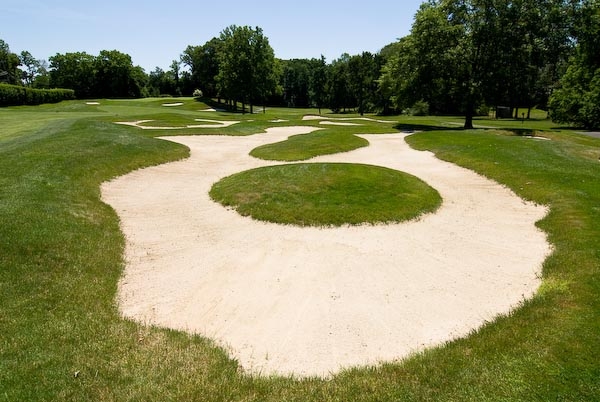
The pride and joy of the new Paramount is the eighteenth hole, a 179-yard par three. Before Urbina gave it his special treatement, it was an anti-climactic finish to your round. Now, it's a shot-maker's delight that will reward the player who makes the right choices and punish the ones who over-reach. The new eighteenth is a "reef hole," a Tillinghast concept that Urbina refined to perfection. The player has three options created by bunkers, ridges, and rough that require absolute commitment to the shot strategy. It can be played short and right, leaving a pitch over bunkers in front of the green, long and left where you'll have a moderate (depending on pin position) chip, or right at the flag--as long as you can float the ball 180 yards and stop it on a dime.

Paramount Country Club (formerly Dellwood) got new owners a couple of years ago. They're sinking money into all facets of the beautiful, classic property including significant upgrades to everything from the banquet facility to the tennis courts. They are to be most heartily commended, though, for their investment in this fine, fascinating golf course.

Among many other books, Dave Donelson is the author of Weird Golf: 18 tales of fantastic, horrific, scientifically impossible, and morally reprehensible golf

Friday, May 22, 2009

North Shore The Way Tilly Made It

One of the finest examples of a well-preserved Tillinghast course is North Shore Country Club's 6,365-yard layout in Glen Head, NY. In fact, the entire club is much like a place where time stopped in 1915, with a creaky, sprawling clubhouse with grand views of Long Island Sound, a lawn dotted with Adirondack chairs under hundred-year-old trees, and a staff that's as relaxed and welcoming as any you'll find anywhere.

But the course is the gem. The rolling hills, steep fairways, and tricky greens demand strategic shot selection. There is a great variety of holes, too, nearly all of which are just about as Tilly designed them.


Of particular interest is the par five third hole, which is only 470 yards but demands a perfect approach to its long, narrow green. Miss just slightly, though, and you'll find your ball in one of the long, narrow bunkers surrounding it.

North Shore has a fine history, too, having hosted the U.S. Amateur, the Long Island Amateur, MGA Open, and MGA Senior as well as several Women's Amateur tournaments. When North Shore co-hosted the 1920 U.S. Amateur Championship, Bobby Jones, Chick Evens, and Fred Wright stode the fairways along with Britain's Lor charles Hope and Cyril Tolley. It wouldn't take much imagination to see them there out of the corner of your eye today.

Dave Donelson, author of Heart of Diamonds a about in the

Tuesday, May 20, 2008

Tillinghast at Saxon Woods

A.W. Tillinghast is renowned as the creator of dozens of world-class golf courses. I was delighted to learn that he also designed my favorite local muni course, Saxon Woods in Scarsdale, NY. It's not likely I'll ever become a member at Winged Foot (although hope springs eternal), but for $25, I can tee it up at Saxon Woods whenever I want.

I'd heard rumors about Tilly's involvement with the Westchester County-owned course, but had poo-pooed them along with everyone else until a friend, Ken Sojka, brought me a copy of Philip Young's limited edition book, A.W. Tillinghast, Creator of Golf Courses. Saxon Woods is mentioned several times and listed as one of Tilly's original designs. The year was 1930, and it was apparent the great man needed the work as depression gripped the country.

Many of the holes at Saxon have been altered, of course, but there are clear marks of Tillinghast's genius throughout the course. The third hole, a long "three-shotter" as he would have called it, has an obviously artificial mound cramping the fairway at the landing area for the second shot as well as two steep-faced bunkers squeezing the green. The fifth hole, my favorite on the course, is a dog-leg par four that offers two strategies off the tee--a well-placed straight drive to the left half of the fairway that leaves a mid iron over another mound, or a long fade to a narrow alley next to the mound that rewards the perfect tee shot with a wedge. The green, too, is highly contoured and protected by a bunker on the right. The 17th hole is one of the best par 3's around, with a steep narrow green set at an angle, surrounded by bunkers, and fronted by a stream. The real Tilly touch is the tee box, which points not at the green but to the right of it.

Another interesting fact is that a well-struck three-wood (or two) would carry your ball from Saxon Woods over the Hutchinson River Parkway to Quaker Ridge. From there, a seven-iron over Griffen Avenue would get it to Winged Foot. I love playing golf in good company.

Dave Donelson, author of Heart of Diamonds a about in the