We've Moved


We've Moved!

Dave Donelson Tee To Green has an exciting new home at
Westchester Magazine.

We're still about all things golf, especially those pertinent to golfers in Westchester and the NY Metro, but now we're in a much bigger space!

Please visit our new home at


Showing posts with label St. Andrews. Show all posts

Saturday, October 4, 2014

St. Andrews Celebrates Landmark Date

Reproduced by permission of The Royal and Ancient Golf Club of St Andrews
I knew there was something special about today, then I realized it's the 250th anniversary of 18 holes at the Old Course.  Not the building of the 18 holes, but the decision to reduce the world’s most famous Links from 22 to 18 holes.  For better or worse, that became the standard length for a golf course wherever the game is played.  The decision was made by the Society of St Andrews Golfers – more commonly known today as the R&A – on October 4, 1764.

On that date, following the Challenge for the Silver Club, a meeting took place of the Society. The minutes read: “The Captain and Gentlemen Golfers present are of the opinion that it would be for the improvement of the Links that the four first holes should be converted into two.”

Reproduced by permission of
The Royal and Ancient Golf Club of St Andrews
The removal of two holes (four in total going out and back) in subsequent years meant the Old Course would become, around that period, 10 holes, of which 8 were played twice.

In the decades that followed the Old Course continued to evolve as the Links and surrounding areas developed, from playing the course backwards through to new greens being built and holes, so familiar to many today, were mapped out across the Links. By the mid-19th Century the 18-hole format at St Andrews had become the blueprint for golf with new and existing courses across the world all following its 18-hole layout.

Euan Loudon, chief executive of St Andrews Links, said: “This important date marks another milestone in the game of golf’s rich history and the special place St Andrews, the Home of Golf, holds for this great game.

“The Society of St Andrews Golfers may not have appreciated the ramifications of the decision they made on October 4 1764 but those individuals and the resultant changes to the Old Course had a huge impact on the way the game would be played forever.

“The records show they took the decision because they sought to improve the Links and that commitment to improving this magical place resonates with everyone here at the Links today.

“Staff across the Links work tirelessly to honor and respect the history of St Andrews and to improve the experience of every golfer coming here, be it the world number one competing this weekend or those securing a cherished tee time in the ballot next week.”

In order to celebrate the 250th anniversary the Links will publish a specially commissioned time-lapse project, which can be viewed at www.standrews.com. It highlights the daily efforts of the greenskeeping team at the Old Course to deliver memorable experiences for every golfer playing the world’s most famous Links.

The time lapse was recorded as the Old Course greenskeeping team, led by Course Manager Gordon McKie, prepared for a day’s play at the Alfred Dunhill Links Championship, which celebrates a 30 year association with St Andrews this week. The hand mowing of the 18th green took 45 minutes to record and required thousands of frames of film.

Among many other books, Dave Donelson is the author of Weird Golf: 18 tales of fantastic, horrific, scientifically impossible, and morally reprehensible golf

Tuesday, July 22, 2014

Great Offer for 2015 Open Championship

Photo little

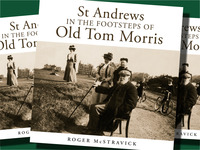
Have you made your plans for the 2015 Open Championship at St. Andrews?  If you still have some options, consider a unique offer from the author of St. Andrews – In the Footsteps of Old Tom Morris. Golf historian Roger McStravick has produced a beautiful photo-rich book that guides readers around the historic sites of this ancient town known as The Home of Golf.  The new book presents remarkable new findings about St. Andrews and legendary Old Tom Morris, who is considered golf’s founding father.

In order to publish St. Andrews – In the Footsteps of Old Tom Morris, McStravick, who resides in St. Andrews, has turned to the fund-raising site Kickstarter with the goal of raising $38,000 to cover the print and production costs for 2,000 books with an anticipated late fall or winter 2014 release.  To make a donation to help publish this engaging guide, visit
https://www.kickstarter.com/projects/1527571987/st-andrews-in-the-footsteps-of-old-tom-morris.

Here's the unique offer: A pledge of $8,500 will reward the first donor with use of a two bedroom house for seven days during the 2015 Open Championship in St. Andrews, plus a personal tour of the town and lunch in The St. Andrews Golf Club, overlooking the 18th green of the Old Course. Short of a spot playing in the Open, I don't know how you could top that!

McStravick’s exhaustive three years of research in the University of St. Andrews’ golf collection archives resulted in the discovery of new information about Old Tom, many unpublished rare photographs, and unknown stories about the Old Course, including the naming of its bunkers. The 240 page book offers a fresh perspective on St. Andrews and the town’s famous 19th century residents who made it truly special.

An important part of McStravick’s mission in writing St. Andrews – In the Footsteps of Old Tom Morris, is a campaign to get signage on the town’s historic sites so visitors can identify and locate the homes of famous past golf champions. The book’s guided tour starts at Old Tom’s house at 6 Pilmour Links and ends at his grave in the ruins of the cathedral’s cemetery.

McStravick recently produced and wrote scripts for an iPad application, “Golf History with Peter Alliss.”  Roger is an avid collector of rare books on St. Andrews and a keen competitive golfer.  For the 2014 St. Andrews Links Yearbook, he has written a history of the Eden Course, which is enjoying its centenary year, and a story on the evolution of St. Andrews’ Old Course.

Among many other books, Dave Donelson is the author of Weird Golf: 18 tales of fantastic, horrific, scientifically impossible, and morally reprehensible golf
Thursday, January 30, 2014

Old Tom Morris Golf Shop Located at St. Andrews

The location of Tom Morris’ first golf shop has been discovered in manuscripts from the Golf Collection in The University of St. Andrews Special Collections Department. Local golf history writer Roger McStravick, who was carrying out research for a book on the man known as the ‘Grand Old Man of Golf,’ discovered a statement known as a precognition given by Tom Morris himself around 1878 detailing how he built in that same year his own shop beside the St. Andrews Links at what is today 15 The Links.

Dr. Anthony Parker, Curator of the Golf Collection at The University of St. Andrews, stated, “We are all very excited by this find.  The University has a vast golf collection going back centuries and this news of Tom Morris’ first shop is very likely to be the first of many new findings to come out of the collection.”

Roger McStravick (right) and Anthony Parker (left)
“There has always been a gap in Old Tom’s story from 1848 to 1851, before he left St. Andrews to create the course at Prestwick,” McStravick said. “In a pile of very old papers, I noticed a statement from Tom amongst the precognitions taken at the time of the Road Wars, when the town was trying to decide whether to have a road along the side the 18th hole of the St. Andrews Links. In his statement talking about his life around 1848, Tom says that he built his own shop and through statements by others at the time, including the father of the R&A John Whyte-Melville and club maker Robert Forgan, I was able to identify the exact location for this little shop at what is today 15 The Links. I was also delighted to discover from the same precognitions that Daw Anderson, who is known as the ginger beer seller, had his own golf shop at 9 The Links with his son and three time Open champion Jamie Anderson living upstairs for almost 10 years during his Open winning days. Daw was so much more than just a ginger beer seller and thanks to the University’s archives his true story is beginning to emerge.”

Mrs. Sheila Walker, a great-granddaughter to Tom Morris, welcomed the news saying, “There has been a lot of study around my great-grandfather and it is always very exciting when new finds are discovered. Roger is to be commended for his work and, importantly, this highlights just how essential the University’s golf collection is to golf historians and to the field of golf research. I understand the University has ambitions to create a dedicated centre for golf-related materials in St. Andrews and this recent finding is proof, if proof were needed, how vital and appropriate it is to have the centre of all golf knowledge in St. Andrews.  If there was ever a logical place to establish an academic centre for golf in the world, then it is surely here.”

Mr. Peter Crabtree, co-author of Tom Morris of St. Andrews: The Colossus of Golf, 1821-1908, also heralded the find saying, “I am always delighted when new research reveals more about Tom Morris. He was a rare character who in addition to being a four time Open champion, helped create the Old Course in St. Andrews as we know it today. The front nine is virtually his own work under the auspices of the R&A Green Committee. We owe so much to Tom Morris and I am delighted the location for his very first shop, at what was a crucial moment in his life, has been discovered.”

“My book would not have been written or the research carried out, if it wasn’t for Peter Crabtree and the late Dr. David Malcolm’s inspirational book on Old Tom, plus the work of David Joy and in particular his portrayal of the great man,” commented McStravick.  “It was his re-telling of Tommy’s story during a performance of Old Tom Morris at The Byre Theatre that struck a chord with me and ultimately led me to this finding.  Without their work, I would not have made this discovery.”

Regarding the Centre for Golf Collections, Dr. Anthony Parker added, “This new research by Roger is a shining example of what can be achieved from the University’s collection. The University’s hopes for a purpose built Special Collections facility to host its golf collection has caught on with many of the greatest golf collectors and organisations around the world donating rare books, photos and written material already. We are currently engaging in consultation with a wide number of bodies about our aspirations.’

Among many other books, Dave Donelson is the author of Weird Golf: 18 tales of fantastic, horrific, scientifically impossible, and morally reprehensible golf

Saturday, March 2, 2013

Caddying At St. Andrews

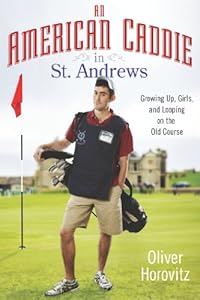
An American Caddie In St. Andrews
At least once in their life, every golfer should make the pilgrimage to the Old Course in St. Andrews. Oliver Horovitz not only made that trip, he turned it into a coming-of-age book about his experiences working as a caddie there during his college years. An American Caddie in St. Andrews is an enjoyable, light read that covers the young man's summers looping on the Old Course while completing his education at Harvard, chasing girls, and pub crawling through the ancient town.

If you're a golfer looking for hole-by-hole insights into the Old Course, you'll probably be disappointed in this book. On the other hand, if you'd like to know what really goes on in the caddie shack, you'll be rewarded by the many tales Horovitz tells. As most of us have long suspected, caddies don't exactly have positive opinions of their clients. A tip less than 100% of the standard fee is generally met with disdain, for example. The caddies also have a private language for ridiculing their players--often right in front of them--to other caddies. It's not unusual for a caddie to purposely give wrong information to a player just for the sake of having a funny story to tell when they get back to the shack. Basically, two types of golfers are accorded caddie respect: scratch players and celebrities. The former gives the caddie fewer errant balls to look for and the latter gives them something to gossip about.  If you don't fall into either of those categories, according to Horovitz, you're just another chump, at least as far as the caddies at St. Andrews are concerned.

There are some non-golf story elements that turn the book into a memoir of sorts. The author chases girls and catches a few, shares various bachelor-pad type apartments with other caddies, and spends one summer filming the caddies as an assignment for one of his classes at Harvard. He also develops a fond relationship with an elderly uncle who lives in St. Andrews. A recurring theme is the way he was treated by the old caddies at the course and how, over time, he earned their trust and respect.

Among many other books, Dave Donelson is the author of Weird Golf: 18 tales of fantastic, horrific, scientifically impossible, and morally reprehensible golf
Saturday, February 23, 2013

Saint Andrew's Scores First After First

Here are a few historical facts about St. Andrew's Golf Club in Hastings, NY, guaranteed to astound your friends and golf trivia fanatics:

 • Saint Andrew’s is the oldest continuously existing golf club in the United States, established on November 14, 1888.

The first photograph of golf in America.
Harry Holbrook, A.P.W. Kinnan, J.B. Upham, and John Reid
 with caddies Warren and Frederic Holbrook at St. Andrew’s.
photo courtesy of the club
The first photograph of golf in America was taken at Saint Andrew’s in 1888.

The first recorded mixed foursome in America was played at Saint Andrew’s. Mrs. John Reid, paired with J. B. Upham, defeated the team of Miss Carrie Law and John Reid on March 30, 1889.

The first known American golf “clubhouse” with its rudimentary “19th hole” (the famous apple tree) was established at Saint Andrew’s in 1892.

Saint Andrew’s was a participant in the first inter-club team matches played in the US on October 9, 1894, along with Tuxedo (host), Brookline, and Shinnecock Hills. Saint Andrew’s tied for first place with Brookline but was unable to stay another day for a play-off, since the first US Amateur/US Foursome/US Open tournaments (October 11-13) were beginning in two days time at Saint Andrew’s.

Saint Andrew’s was the host of the first U.S. Amateur Championship, held under match-play format (as all the UK tournaments of the period were conducted), in 1894.*  The first U.S. Amateur Championship was won by a Saint Andrew’s member, L. B. Stoddart, in 1894.*

Saint Andrew’s hosted the first US Open Championship, in 1894.*

Saint Andrew’s hosted the first U.S. Foursome (two players per team playing alternate shots) Tournament, in 1894.  Held in conjunction with the above-mentioned U.S. Amateur and U.S. Open championships, this event was short-lived on the national scene.

The team of L.B. Stoddart and J.B. Upham from Saint Andrew’s won the inaugural US Foursomes Tournament, 1894. They defeated another Saint Andrew’s pair, T.C. Ten Eyk and W.E. Hodgeman, in the all-Saint Andrew’s final.

Saint Andrew’s member/official Henry O. Tallmadge suggested and organized the December 22, 1894, meeting of five golf clubs at the Calumet Club in NYC, which resulted in today’s USGA.

Saint Andrew’s published the first Club Yearbook (or Club Handbook) in the U.S. containing a list of members, officers of the club, the various committees, and constitution and by-laws, in 1895.

The first golf club in the U.S. formed by women was the Saegkill Golf Club, organized by Saint Andrew’s women (Mrs. John Reid among them), in 1895.

Saint Andrew’s organized and funded the first U.S. Public Links Tournament at Van Courtlandt Park (the first public course in the U.S.), with a field of 50 golfers officiated by John Reid, in 1896. This tournament was “for players who did not belong to a club in the United States Golf Association.”

Saint Andrew’s member Charles E. Sands won the first-prize gold medal for golf at the Paris Olympic Games in 1900, the first year golf was included in the Olympic Games.

*These championships are regarded by some as unofficial, as they were held prior to the formation of the USGA the following year. However, there is no dispute that they were the first amateur and open national golf championships ever held in the U.S.

For more Westchester golf history, check out the May issue of Westchester and Hudson Valley Magazines.

Among many other books, Dave Donelson is the author of Weird Golf: 18 tales of fantastic, horrific, scientifically impossible, and morally reprehensible golf

Friday, November 23, 2012

St. Andrews Toughens Up

The St. Andrews Links Trust has announced that a number of improvements are planned for the Old Course to help maintain its challenge for the world’s top golfers when they return to play The Open Championship in 2015.

St. Andrews
Golf course architect Martin Hawtree was commissioned to find potential changes that would challenge elite players without unduly affecting club and visiting golfers. His other charge was to make sure the revisions were true to the special character of the Old Course.

The work is planned to take place in two phases over this winter and next. The first phase involves work on the 2nd, 7th, 11th and 17th holes. The second phase will take place in winter 2013/14 with work on the 3rd, 4th, 6th, 9th and 15th holes.

Euan Loudon, Chief Executive of St Andrews Links Trust, said, “The Old Course is renowned as one of the great Open venues and its continued prominence on the Open roster is crucially important to the economy and reputation of St Andrews. The Old Course has evolved over time and the Links Trust is delighted to be working with the Championship Committee in order to maintain the challenge of the course for elite tournament players and the thousands of golfers who play here each year.”

Peter Dawson, Chief Executive of The R&A, added, “We have considered the challenge presented to the world’s top golfers by each of The Open Championship venues and carried out a program of improvements over the last ten years. While some holes have been lengthened on the Old Course in recent years it has otherwise remained largely unaltered. The Championship Committee felt there was an opportunity to stiffen its defenses in some places to ensure it remains as challenging as ever to the professionals. The proposals from Martin Hawtree should place more of a premium on accuracy and ball control while retaining the spirit and character of the Old Course.”

According to the information released today, here's what's going to happen:

Phase 1

  • On the 2nd hole, the two bunkers right and short of the green will be moved closer to the right edge of the green. The ground to the right of the green will also be re-contoured to create more undulations and the width of 3rd tee will be reduced to accommodate this. Two bunkers on the right side of the fairway, near the 3rd Championship tee, will be removed.
  • On the 7th, the large depression in the landing area of the fairway will be filled in and a slight mound created. The area to the right of the green will be remodeled to create more undulations.
  • On the 11th, the back left portion of the green will be lowered to create more hole location options.
  • On the 17th, the Road Bunker will be widened by half a meter at the right hand side and a small portion of the front of the green will be re-contoured to enable it to gather more approach shots landing in that area.

Phase 2

  • On the 3rd hole, the first fairway bunker on the right will be removed. A new fairway bunker will be added into the bank on the right hand side about 275 yards from the Championship tee.
  • On the 4th, the acute spur formation on the left hand side of the fairway will be reduced and the bunker on the right hand side of the green will be moved closer to its edge. The ground to the back right of the green will be re-contoured.
  • On the 6th, the ground to the right of the green will be re-contoured.
  • On the 9th, a fairway bunker will be added short and left of the green, about 25 yards to the left and diagonally towards the green from the last bunker on the right of the fairway.       
  • On the 15th, the ground to the back right of the green will be re-contoured to create more undulations.

Among many other books, Dave Donelson is the author of Weird Golf: 18 tales of fantastic, horrific, scientifically impossible, and morally reprehensible golf

Monday, December 19, 2011

Swing Science At St Andrews

It may be home to the Old Course, but there's nothing ancient about the teaching facilities at St Andrews. A new biomechanics system has been introduced at St Andrews Links Golf Academy and it promises to measure the golfer's swing in ways you can't imagine. The system was developed by an Olympic athlete to monitor a golfer's movements using small sensors to detect rotational and translational movement of the segments of the body during the swing.

The Advanced Motion Measurement (AMM) System is used by a number of top players on the PGA Tour. The system was developed by Stephen Cheetham and his brother Philip, an Australian gymnast who competed in the 1976 Olympics in Montreal. They founded AMM in 2003 to develop motion measurement products which can be used to improve the physical performance of athletes and to reduce the chances of injury.

The data from the swing motion measurement can then be fully analysed using TPI3D analysis software. The team of PGA professionals at the St Andrews Golf Academy, led by director of instruction Steve North, will use the system in their coaching programs to deliver precise swing improvement tips for their clients. It monitors elements such as sway, lift and thrust, pelvis rotation, forward bend and side bend.

“This is an impressive system which will give us a great deal of useful data in terms of analysing clients’ swings and precisely identifying aspects they need to improve,” said Steve. “It captures over 200 different parameters of the swing which will enable us to zero in very quickly on areas of weakness and to monitor improvements in performance. We are focused on delivering the best coaching we can to our clients using instruction techniques tailored to the golfer’s requirements and utilising the most advanced technology available.”

The AMM system is the latest addition to an array of technology used in the Golf Academy including Trackman ball tracking system, SAM PuttLab, K-Vest, SAM BalanceLab, V1 analysis software and online platform. The Golf Academy delivers coaching through its team of four PGA professionals and club fitting services through the Custom Fit Centre.

In addition to writing about golf, Dave Donelson distills the experiences of hundreds of entrepreneurs into practical advice for small business owners and managers in the Dynamic Manager's Guides, a series of how-to books about marketing and advertising, sales techniques, motivating personnel, financial management, and business strategy.

Monday, November 28, 2011

A Better Chance To Play The Old Course

Here's some welcome news from St Andrews. Effective next year, the ballot for tee times on the world famous Old Course will be drawn two days ahead effective in January 2012. The ballot has been drawn one day ahead for many years but St Andrews Links Trust, which manages the seven public courses in the town, is making the change to help players plan their golf more effectively.

On Saturday, January 7, 2012, the ballot will be drawn for Monday, January 9 and will continue to be drawn two days ahead from then onwards.

The 48 hour ballot will dovetail with the one-day ahead booking system on the Castle, Jubilee, Eden and Strathtyrum courses and will enable golfers who have been unsuccessful in the ballot to book an alternative course for the day they want to play. The earlier draw will make it easier for visiting golfers to plan accommodation and travel arrangements and will encourage them to stay longer in St Andrews and play more golf in and around the town.

Euan Loudon, Chief Executive of St Andrews Links Trust, said, “The ballot is designed to ensure that golfers who haven’t been able to book in advance still have a chance to play the Old Course. It has been drawn one day ahead for many years but we conducted an extensive consultation exercise with a range of different stakeholders and the feedback was that people felt drawing it two days ahead would make it much easier for people to plan their golf. We believe the change will help to improve the experience of playing in St Andrews and to ensure that people have more opportunity to book golf on the other courses.”

To enter the ballot requires at least two golfers and they will have to enter their names, home clubs and handicaps by 2pm. The ballot will take place every day of the week with the exception of Friday as there is no play on the Old Course on Sundays. The entries can be made by phone on 01334 466666 or in person at any of the three clubhouses at the Links.

In addition to writing about golf, Dave Donelson distills the experiences of hundreds of entrepreneurs into practical advice for small business owners and managers in the Dynamic Manager's Guides, a series of how-to books about marketing and advertising, sales techniques, motivating personnel, financial management, and business strategy.

Friday, November 18, 2011

Great Golf Art On Line

Collectors and admirers of the finest golf art have a new online resource, St. Andrews Golf Art, where they can find work from highly regarded contemporary artists who have memorialized the game’s legends, historic courses and iconic competitive moments on canvas, in sculptures, illustrations or other media.

Renowned international artists were selected for the online launch of St. Andrews Golf Art, including Walt Spitzmiller, Joe Austen, Adriano Manocchia and Simon Russell. Their sought-after work is exhibited in museums, galleries and clubhouses, as well as held in private and corporate collections around the world. Each artist has a distinctive style that showcases aspects and interpretations of the game’s rich heritage and vital spirit.

Walt Spitzmiller

Walt is one of the world’s foremost sporting artists and his work is widely held by private and corporate collectors, including many golf legends such as Arnold Palmer, Jack Nicklaus, Tom Watson as well as the PGA TOUR. For many years, Walt’s art regularly illustrated stories in Sports Illustrated and GOLF Magazine, and he was the chief contributing artist to Senior Golfer Magazine.

Joe Austen

Joe is one of the world’s foremost painters of sports portraits. His oil paintings are exhibited in clubhouses and hotels in the United States, Japan and Europe and in prestigious private and corporate collections throughout the world. The Austen Gallery in the Macdonald Rusacks Hotel in St. Andrews, Scotland houses many of Joe’s impressive works, including the ambitious “World of Golf” (16’ x 10’) and the mesmerizing multiple swing action sequence portrait of Jack Nicklaus.

Adriano Manocchia

Adriano began his career as a photojournalist and traveled the world covering news events. In 1984, he started painting and quickly received the attention of collectors and art critics worldwide. Many of his early works concentrated on landscapes and the great outdoors. In 1992, Adriano was introduced to golf when the USGA commissioned him to paint a series of oils of famous courses. The PGA TOUR recently commissioned Adriano to create a major painting of the Tour’s new clubhouse at Sawgrass, with the 18th hole in the foreground, and the work is on display in the clubhouse’s Champions Room.

Simon Russell

Simon Russell is the pseudonym of a hyper-realist artist from the former Soviet Republic and is now resident in one of the new states surrounding Russia. He has a very fine eye for detail, having honed his talent in the etching of photography for gravestones. His depiction of golfers such as Seve Ballesteros, Tiger Woods, Jack Nicklaus, Gary Player, Greg Norman, Payne Stewart, Colin Montgomerie and others is captivating, as is his interpretation of The Old Course’s famous Swilcan Bridge.

St. Andrews Golf Art also welcomes inquiries for special commissions from golf clubs, corporate clients or individuals who appreciate the appeal of acquiring a significant piece(s) of art from one of the world’s foremost golf artists. This could include incorporating a series of relevant pieces for a themed area, room or corridor of a clubhouse or private residence. For further information, contact Alasdair Busby at www.standrewsgolfart.com or by telephone 0044 (0)7757 358918.

In addition to writing about golf, Dave Donelson distills the experiences of hundreds of entrepreneurs into practical advice for small business owners and managers in the Dynamic Manager's Guides, a series of how-to books about marketing and advertising, sales techniques, motivating personnel, financial management, and business strategy.

Tuesday, September 14, 2010

I'm Waiting For My Review Copy

A truly remarkable golf book was released today, but you probably won't find a copy on the discount table at your neighborhood Barnes & Noble. It's “The Golf Links of Scotland,” an ultra-deluxe, hand-tooled leather-bound tome that is the ultimate hole-by-hole tour--at least by price--of the venerable Old Course at St. Andrews as well as a tribute to 18 other top Scottish seaside links. Noted golf photographer and St. Andrews resident Iain Macfarlane Lowe joined forces with golf writer/editor extraordinaire George Peper to produce a limited edition collector’s volume that is now on sale for a mere $4,600. Hurry, though, the price goes up January 1.

Only 150 copies of “The Golf Links of Scotland” will be printed with 145 made available for purchase. In pre-release publicity, it's said, "The artistic blend of Lowe’s exquisite photography with Peper’s elegant and insightful prose transports the reader into an intimate appreciation of the character and nuances of every hole on the Old Course." I haven't received a review copy for some reason, so I can't attest to that, but I'll take their word for it. Novel and informative transparent overlays on aerial shots also provide useful play lines and yardages for all 18 holes and combined with the wisdom of “local knowledge” professional tips serve as a valuable guide to negotiate the course. How well you hit the ball there is up to you.

“The Golf Links of Scotland,” is two books in one. Book One devotes 130 pages to the Old Course while Book Two visits 18 other Scottish coastline gems in the span of 170 pages of descriptive text, playing tips and stunning photography. The highlighted links include: Royal Troon, Royal Dornoch, Carnoustie, Turnberry, Prestwick, Muirfield, Royal Aberdeen, North Berwick and Kingsbarns.

As a further personalized touch to the 145 editions, Lowe has signed and numbered an exclusive, unpublished photograph printed on highest quality fine art paper and bound into each book, making it suitable for removal and framing. “The Golf Links of Scotland” is handsomely presented in a hand-made clamshell case. The oversized book’s leather binding is graced with 23-carat gold leaf inlay that includes four thistles on the cover corners. Lowe, acclaimed as St. Andrews’ “official” golf photographer, spent four years capturing the most majestic shots of the courses represented. Additionally, four spectacular double-gatefolds (50” x 12”) are inserted to give the reader an even closer look at some of these renowned courses.

“The Golf Links of Scotland” costs more than a trip to the Old Course, but it certainly would make an exceptional gift for the historian or avid golf collector. To order your copy, contact Iain Lowe at iain@golflinksofscotland.com or for more information and sample pages visit www.golflinksofscotland.com.

Dave Donelson, author of Heart of Diamonds a about in the

Tuesday, April 1, 2008

St Andrews April Fool


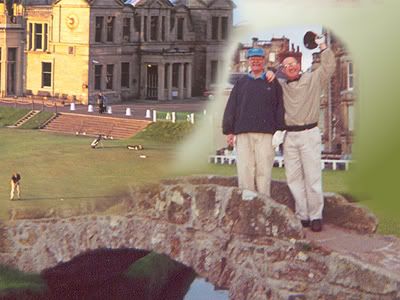
Beau and Dave on the Swilcan Bridge, 2001

It's not an April Fool's Day gag. The traditional season opening event at St Andrews Links is a weekend when the Old Course is played backwards for three days.

During the Old Course in Reverse event, golfers get to play the Old Course on its original clockwise routing starting from the first tee and playing to the 17th green, then the 18th tee to the 16th green and so on.

The Old Course was played in this direction until the 1870s when Old Tom Morris created the present first green. This made it possible to play in the anti-clockwise direction. In fact, until the early 20th Century the course was played in both directions in alternate weeks.

Until the 1970s the course was set up in the clockwise direction for four weeks in the winter. St Andrews Links Trust, which manages and maintains the seven public courses in St Andrews including the Old Course and the new Castle Course, recently revived this routing and it has proved popular as a season-opening event.

Dave Donelson, author of Heart of Diamonds a about in the